

“When the Spirit of truth comes, He will guide you into all the truth; for He will not speak on His own authority, but whatever He hears He will speak, and He will declare to you the things that are to come.” John 16:13
Today, we continue the Last Supper discourse found in the Gospel of John. In this section of the discourse, Our Lord gives a catechesis on the coming of the Holy Spirit and what His role is in the Church. It is fitting that the Church has given us these readings immediately before the feast of the Ascension, which is the necessary precursor to the coming of the Spirit.1
For today, I want to concentrate on the role of the Spirit in the teaching of the truth. Our Lord says that the Spirit will guide you into all truth. To find out what Our Lord is saying, it is important to understand this passage in light of the 2000-year history of the Catholic Church, and who specifically Our Lord is speaking to here. First, it is important to connect this role of the Holy Spirit to Divine Revelation, that through the guidance of the Spirit, the church is guided to know all that is necessary for salvation regarding the Deposit of Faith, that is, Sacred Scripture and Sacred Tradition. In God’s goodness, He has revealed to man all that is necessary for salvation, and we are obligated to come to know this truth, as St. Thomas writes: “It was necessary for man’s salvation that there should be a knowledge revealed by God… that certain truths which exceed human reason should be made known to him by divine revelation.”2
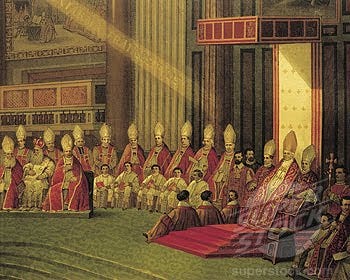
The Catholic Church has consistently taught that the authentic interpreter of this revelation is the Magisterium of the Catholic Church. This is seen in the Gospel for today. When Our Lord is speaking and saying that the Holy Spirit will guide you in all truth, He is not speaking to all of the faithful in a specific sense. Surely, by extension, He is. But most presently, He is speaking to the Twelve, His first Bishops, headed by the first Pope, St. Peter.3 No one else is present at the Last Supper, as the Gospels tell us: “When it was evening, He sat at table with the twelve disciples…”4 This is a detail affirmed specifically for two reasons:
It is the Twelve to whom He gives the command to transubstantiate the bread and wine into His body and blood, Do this in memory of me.
For the purposes of this reflection, it is the Twelve to whom He promises the Spirit to guide them to all truth.
These two aspects of the Apostolic Office are immensely important; they are sacramental and authoritative in nature. Meaning that the authority of the office of Bishop (the Eleven), united to the Pope (Peter), is given to the Apostles along with the promise that the Spirit will guide them. By extension, He will then guide the faithful of the Church.
Some might object to this line of thinking and say that the Spirit guides each of the faithful individually according to our own conscience. We have to remember, though, that each individual Christian does not have an infallible conscience. The conscience is only as reliable as the formation it has received. More than that, private interpretation of either Scripture or Tradition leads to a broad Subjectivism. What prevents one of the faithful from interpreting revelation in one way and another of the faithful from contradicting him? Surely, we are not passing out the charism of Infallibility to all persons through Baptism? There is no objective standard when interpretation is left solely up to the individual. The Magisterium of the Church guarantees that there is an objective interpretation of these truths. Last week, I wrote a Primer on the Magisterium, find it linked here:

This is why Our Lord promises the Holy Spirit to this extent in the context of this discourse, specifically to the Apostles, and not in a broad teaching to all the people. Make no mistake, those who have been baptized and confirmed, and remain in a state of grace, possess the indwelling of the Holy Spirit as a guide and promoter to holiness. The reality of the Magisterium does not deny this. But that same Spirit dwells within us, not to give us an infallible knowledge of the truth derived from the subjectivism of private interpretation, but to inspire in us the virtues of humility and obedience to submit to the Keys and listen to the Magisterium of the Catholic Church.
For more from Dr. McGovern, visit his Substack at A Thomist, Dedicated to the Theological tradition of St. Thomas Aquinas. Exploring Thomas’ Spiritual Theology and topics in Christology and Mariology.
Cf. John 16:7.
St. Thomas Aquinas, Summa Theologiae, Ia q. 1, a. 1.
Cf. Matthew 16:18.
Matthew 26:20.
From an abysmally formed RCIA Catholic I thank you for both essays…they have helped clarified so much for me.
Written in such a clear and factual way. Thank you. What you wrote is 100% o the spot and we have proof of it being true because we have experienced and are still experiencing the lack of this in Protestants who therefore are missing out on so much .They lack a very important part because they think they themselves can understand, just by reading the Scriptures alone. Sola Scriptura. This has led to so many opinions and splitting of churches which are now more than 40.000 in numbers. Not even mentioning the wars that have been waged and so many people have suffered. I always say that this was to be expected because the EVIL ONE hates Jesus and therefore hates His church. Therefore persecuting His church was to be expected and He even warned us of that. Some of our famous Catholics who were Protestants to start with, realised this and converted.
"The Gates of Hell will NOT overcome it "he promised us about His church. Here we are 2000 years later and His church still stands.