
He Who Sees Me, Sees Him Who Sent Me
Gospel Reflection for Wednesday, April 29th, 2026: Feast of St. Catherine of Siena

“And Jesus cried out and said, ‘He who believes in me, believes not in me but in him who sent me. And he who sees me sees him who sent me.’” John 12:44–45.
Authority is an immensely important reality within the context of human life. It is even more important in the life of the Church. Our Lord expresses this fact in the Gospel for today. It is Christ who comes in the name of God, the Father. The Son is sent to reveal the Father and to lead man to union with God. This is the glory of the Incarnation, that God becomes man so that the rift between man and God can be repaired, and we might have eternal life, as Our Lord says further on, “And I know that his commandment is eternal life. What I say, therefore, I say as the Father has bidden me.”1 God desires that eternal life be given to those who would follow the words of Christ. Thus, there is an explicit connection between obedience and salvation.
This should not come as a surprise to us, as it was through disobedience that man fell in the beginning.2 That disobedience brought about Original Sin and cut man off from God. In like manner, according to a sublime fittingness, Our Lord repairs that disobedience with an example of obedience in His absolute abandonment to God in the Garden of Gethsemane:
“…nevertheless not my will, but yours, be done.” Luke 22:42.
Thus, the necessity of obedience is emphasized by Christ. To tie this into today’s Gospel, Our Lord emphasizes that in believing in Him, by extension, you believe in the Father. The converse is true as well; if we reject Christ, we are rejecting the Father. We should, likewise, carry this down from Christ to those whom He has sent just as the Father has sent Him. This is why the Lord tells the Apostles, “He who hears you hears me, and he who rejects you rejects me, and he who rejects me rejects him who sent me.”3 The Apostles and their Successors have been given the authority of governance in the Church, with Peter at the head.4 Thus, we ought to have a disposition of obedience to St. Peter and his successors and to the Bishops of the Catholic Church. We must have an ardent desire to stay within the Barque of Peter, as outside of that Ark, there is no salvation,5 as foreshadowed by Noah and the Flood.6
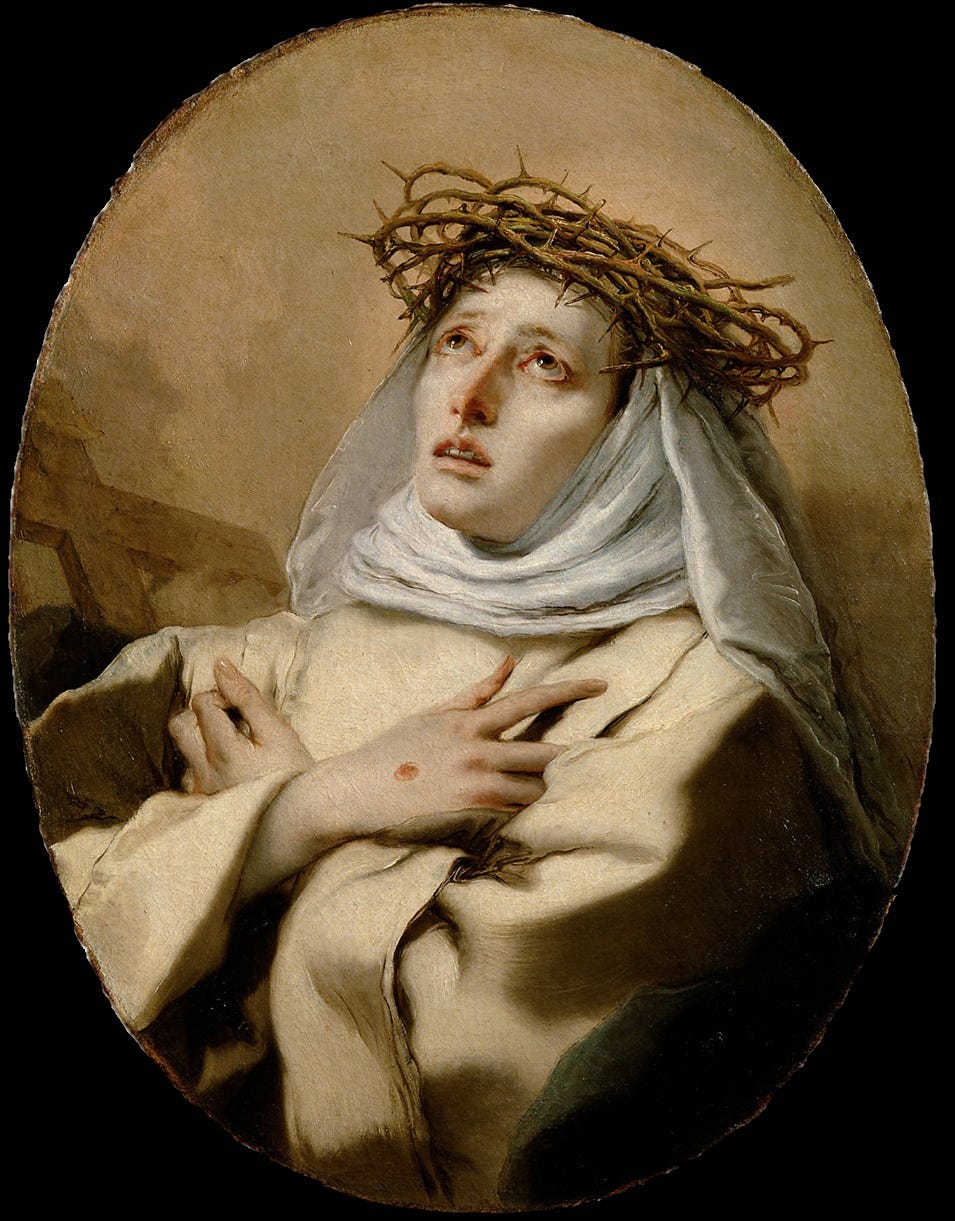
Today’s feast day is of a saint particularly close to my heart, St. Catherine of Siena. The Mystic of Siena labored during a time of great confusion in the church when the Pope resided in Avignon. After Pope Gregory XI returned to Rome under Catherine’s influence, he died, and Pope Urban VI was elected. From there, the French Cardinals elected their own pope, and the Great Western Schism began. During this time, even though Urban VI was a volatile figure and was not very well liked, Catherine continuously promoted obedience to the true pope against the anti-popes of Avignon.
This great Mystic reminds us of the necessity of obedience. That is when we listen to the Holy Father within the context of faith and morals; we are listening to Christ. Not everything the Pope says is infallible. Not everything the Pope says is even authoritative. The levels of assent given to Church teaching are a very nuanced subject.7 But one principle, to my mind, seems to be the foundational approach when it comes to Magisterial teaching:
If we approach magisterial teaching with a starting point of “Do I have to obey this?” We have begun in a fundamentally flawed place.
This does not mean that we will not struggle. This does not mean that it won’t be hard, as is demonstrated in the times of St. Catherine of Siena. We have to encounter ambiguity and even the scandal of bad popes and prelates. Not all live up to the immense call that Christ has given. That is the reality.
But the Catholic position is to be a St. Catherine.
At the end of the day, obedience, prudence, and humility are the key virtues that every Catholic must embody in our consideration of what is said by our shepherds. These are non-negotiable. These, then, must be ordered toward charity and justice. St. Thomas teaches on judgment:
As stated above (A. 3, ad 2), from the very fact that a man thinks ill of another without sufficient cause, he injures and despises him. Now no man ought to despise or in any way injure another man without urgent cause: and, consequently, unless we have evident indications of a person’s wickedness, we ought to deem him good, by interpreting for the best whatever is doubtful about him.8
This means, all things being equal, we are to assume the best intentions out of charity when it comes to our neighbor. This includes our superiors, especially the Pope and the Bishops in union with him. We are bound to interpret their words in charity. This benefit of the doubt only ends when there is manifest and undeniable danger to the faith.9 For St. Thomas, this is a clear departure from ambiguity and matters of prudence and entrance into objective and undeniable contradiction. Unless we find ourselves in a place where there is such a publicly manifest contradiction of Church teaching, we are to proceed according to charity as the Angelic Doctor reminds us.
These are important matters that Our Lord reminds us of in today’s Gospel. Obedience, humility, and prudence are key in the life of the Catholic. We must keep ourselves aligned with the perennial teachings of the Catholic Church according to these virtues. In addition, St. Thomas warns us against rash judgment, teaching that we need urgent cause to think ill of another man. How would our spiritual lives be different if we followed the Angelic Doctor on these matters and refrained from rash judgment? An error that is dangerous to the faith must be called out, especially if it is by a prelate. But the prudential guidance of the Church’s greatest theologian is that it must only be done in the case of a manifest and clear danger to the faith, and not in a situation that could be made to look like such.
For more from Dr. McGovern, visit his Substack at A Thomist, Dedicated to the Theological tradition of St. Thomas Aquinas. Exploring Thomas’ Spiritual Theology and topics in Christology and Mariology.
John 12:50.
Cf. Genesis 3.
Luke 10:16.
Cf. Matthew 16:18
The doctrine of outside of the church there is no salvation must always be understood in the context that is laid out according to the CDF document Dominus Iesus from 2000.
Cf. Genesis 7.
In the coming weeks, I will have a longer form article going through these nuances for those who wish to know more about how the Magisterium works and how Catholics must receive the teachings that flow out from this teaching authority.
Summa Theologiae, IIa-IIae, q. 60, a. 4.
Cf. ST IIa-IIae, q. 33, a. 4.
How do we obtain your future writing on the magisterium??
Incredibly moving and beautiful.