
He Spread It Out Before the Lord
Tuesday of the Twelfth Week in Ordinary Time | 2 Kings 19:9b-11, 14-21, 31-35a, 36 | Psalm 48 | Matthew 7:6, 12-14

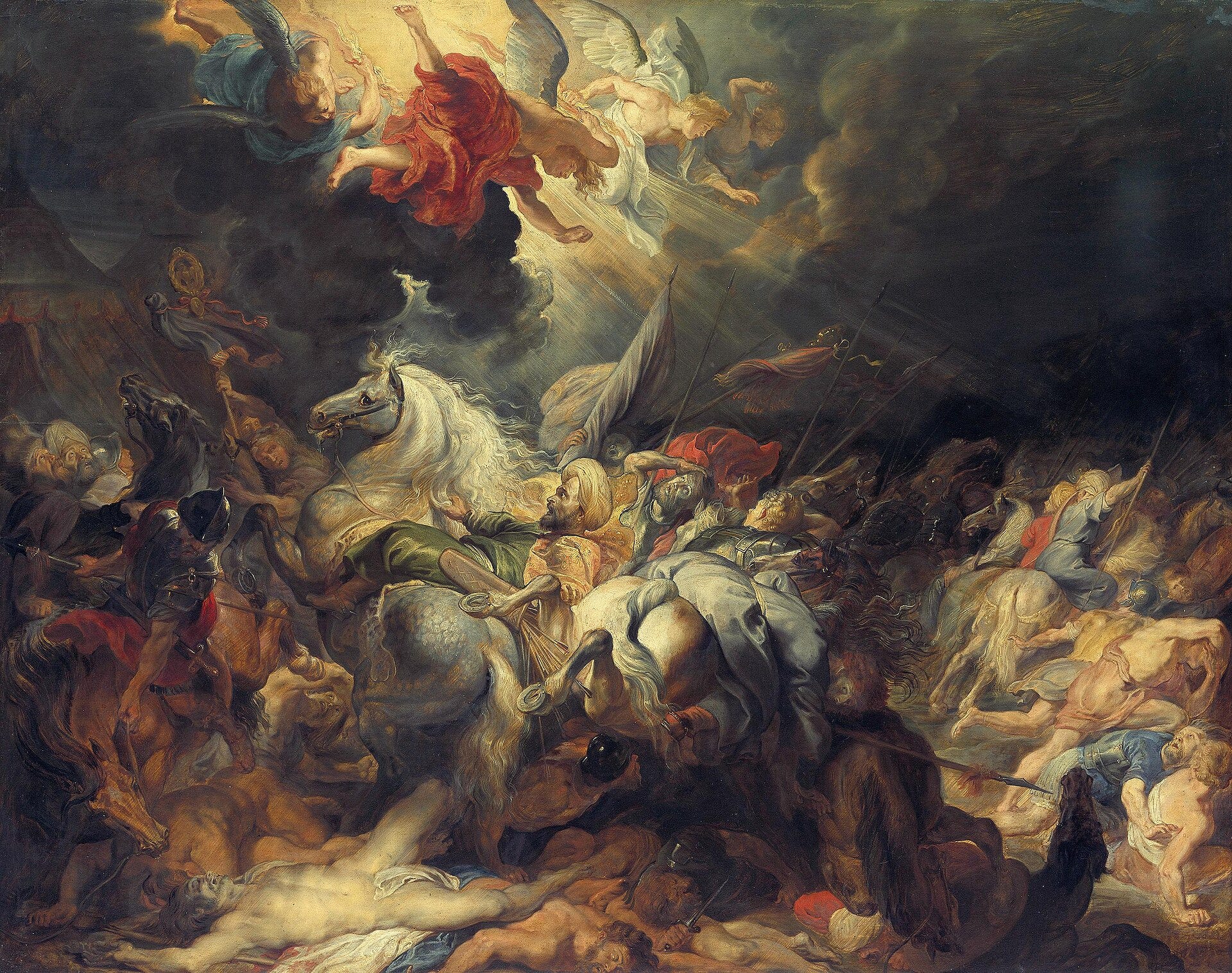
The letter arrives with the weight of an empire behind it.
Sennacherib’s envoys bring it to Hezekiah with the particular cruelty of men who have done this before and know how it ends. The message is not a negotiation. It is a recitation of facts: every nation that trusted its god against Assyria has been destroyed. The gods of Hamath, Arpad, Sepharvaim, Hena, Ivvah - all of them gone. Do not let your God deceive you. You have heard what we do to countries. Will you be saved?
The facts are accurate. Sennacherib is not bluffing. He has destroyed everything he has faced. The letter is a weapon designed to produce the one thing that makes empires possible: the conviction that resistance is futile.
Hezekiah reads it, and then he goes to the Temple. He spreads the letter out before the Lord.
Commentators have noted that to spread the letter before the Lord meant entering the inner sanctuary - the Holy of Holies, or at least the inner court before the ark of the covenant. The history of the ark was not comfortable. Those who approached it carelessly had died for it. Hezekiah walks into that space carrying a piece of parchment with Sennacherib’s name on it, and he lays it down.
He is not being naive. He acknowledges the facts: “Truly, O Lord, the kings of Assyria have laid waste the nations and their lands.” He does not pretend Sennacherib is weak or that the threat is exaggerated. He reads the letter to God. He spreads it out as evidence, as petition, as an act of placing what is before him into the presence of the one who made heaven and earth and is enthroned upon the cherubim.
And then he prays not for himself alone, but for a purpose beyond himself: “save us from the power of this man, that all the kingdoms of the earth may know that you alone, O Lord, are God.”
The prayer is answered. That night, 185,000 Assyrian soldiers are struck down. Sennacherib goes home. He does not come back.
Hezekiah’s work in this passage is the prayer. Everything else is the zeal of the Lord of hosts.
The Gospel today gives us three sayings from the end of the Sermon on the Mount, placed together in a way that rewards slow reading.
“Do not give what is holy to dogs, or throw your pearls before swine.”
Augustine, in his commentary on the Sermon on the Mount, draws out what is holy and what are the pearls: “The holy thing is all that it were impiety to corrupt... the pearls are all spiritual things that are to be highly esteemed.” The dogs, he says, are those who assault the truth; the swine are those who despise it.1 Origen adds that the pearls are the more mystical teachings of the faith - things that require a certain disposition to receive, a willingness to be changed by what one hears.2
This is not about contempt for outsiders. It is a recognition that holy things require a receiving heart, and that to press them on those who have made clear they will only trample them is not generosity but waste - and may result in being torn to pieces. There is a kind of discernment required of those who carry the pearl. Not every moment is the right moment. Not every listener is in the posture of receiving.
Then the Golden Rule: “Do to others whatever you would have them do to you. This is the Law and the Prophets.”
Everything compressed into a single sentence. The Law and the Prophets - the whole inheritance of Israel, the whole moral structure of revelation - distilled into this. Hezekiah is living it: he prays not only for his own deliverance but that all kingdoms may know God. His petition is outward-facing, expansive, wishing for others what he wishes for himself.
And then: “How narrow the gate and constricted the road that leads to life. And those who find it are few.”
This is not pessimism. It is a description of the way the Sermon on the Mount has been pointing all along. The narrow road is the road of the beatitudes, the road of love for enemies, of prayer for persecutors, of almsgiving in secret, of trust in a Father who clothes the lilies and feeds the birds. It runs against every natural instinct of the person who has received Sennacherib’s letter and wants to call the war council.
Hezekiah finds the narrow gate. He goes to the Temple. He spreads the letter out before God. The broad road would have been diplomacy, despair, or military calculation. The narrow road is the one that says: the problem is not primarily political. The problem is theological. And the first response to any Sennacherib is to bring the letter into the presence of the living God and leave it there.
The domestic church receives its own Sennacherib letters. They do not come from Assyria. They come in the form of medical diagnoses, financial challenges, estrangements, the slow erosion of a child’s faith, the marriage that has been under siege for years, the grief that will not resolve. They are designed to produce the same conviction: resistance is futile. This is how things end.
The narrow gate for the household is the same as for Hezekiah. Not to pretend the facts are otherwise. Not to minimize the threat or perform a confidence we do not feel. But to go - physically, in prayer, in the daily practice of the Liturgy of the Hours or the Rosary or whatever form the household’s prayer takes - and spread the letter out before the Lord.
To read it to him. To say: you see this. You see what it says. Save us - not only for our sake, but that all who watch how this household weathers this thing may know that you alone are God.
The pearls are not for the letter. The pearls are what the household guards and cultivates in the inner sanctuary of its daily life - the faith passed to children, the prayer spoken at the table, the holy thing kept from those who would only trample it. The broad road is the road that abandons these things under pressure. The narrow road keeps them, quietly, and waits for the Lord to act.
The 185,000 are not our work. They never were.
Domus Formation offers tracks of daily prayer and formation for families, men, women, teens, and those in the second half of life. The first school of faith is the home, and every member of it deserves to be formed. WeAreDomus.com
If Catholic fiction that takes the Communion of Saints seriously - as doctrine, not sentiment - is what you are looking for, I am writing two things. Lux Perpetua is a serial novel publishing weekly in two tracks, set in Alton, Illinois, at the edge of the Mississippi - a story of custody and fidelity and a flame passed forward across centuries. And Two Lamps is a weekly short story on Substack, each one braiding two saints from different centuries into a single imagined meeting. Both are for the kind of reader who believes the imagination is also a faculty of faith.
Deacon Michael Halbrook is husband to Suzanne, father of four sons, and a permanent deacon of the Diocese of Springfield in Illinois. He serves at St. Elizabeth Parish in Granite City. He is the founder of Domus Formation, a collection of Catholic prayer and formation resources for every stage of life, and he writes at DeaconMichael.net.
Augustine, De Sermone Domini in Monte, II.20.
Origen, Commentary on Matthew, cited in the early patristic commentary tradition on Matthew 7:6; see Contra Celsum I.7 for Origen’s treatment of the mystical teachings as pearls not to be disclosed indiscriminately.
So this is what faith of a child looks like…thank you