
He Makes His Sun Rise
Tuesday of the Eleventh Week in Ordinary Time | 1 Kings 21:17-29 | Psalm 51 | Matthew 5:43-48

Ahab is in the vineyard.
He has wanted this vineyard for a long time - it was next to his palace in Jezreel, and he wanted it for a vegetable garden, and Naboth would not sell it because it was his ancestral inheritance. So Jezebel arranged for Naboth to be falsely accused and stoned to death. And now Ahab has gone to take possession.
This is where Elijah finds him.
The indictment is clear and total: murder, theft, idolatry, leading the entire nation into sin. The text has already told us that “no one gave himself up to the doing of evil in the sight of the LORD as did Ahab.” Elijah’s pronouncement of judgment is proportionally severe - the dynasty, the house, the future, all of it forfeit. The dogs will lick Ahab’s blood where they licked Naboth’s.
Ahab says: “Have you found me out, my enemy?”
Yes, Elijah says. And then pronounces the sentence.
And then Ahab tears his garments and puts on sackcloth. He fasts. He sleeps in the sackcloth. He goes about subdued.
And the LORD says to Elijah: “Have you seen that Ahab has humbled himself before me? Since he has humbled himself before me, I will not bring the evil in his time.”
This moment deserves our attention.
Ahab is not repentant in any deep sense. He does not make restitution to Naboth’s family. He does not renounce Jezebel or her methods. There is no conversion of life recorded, no public confession, no undoing of the damage. He tears his garments and puts on sackcloth - the outward gesture of mourning and humility - and goes about subdued. That is all.
And God sees it and responds to it.
The judgment is deferred, not cancelled. The house of Ahab will still fall. But God, who sees even this much, does not treat even this inadequate gesture as nothing. He receives it and accommodates to it. He does not demand that Ahab become a different man before extending a measure of mercy to the man he is.
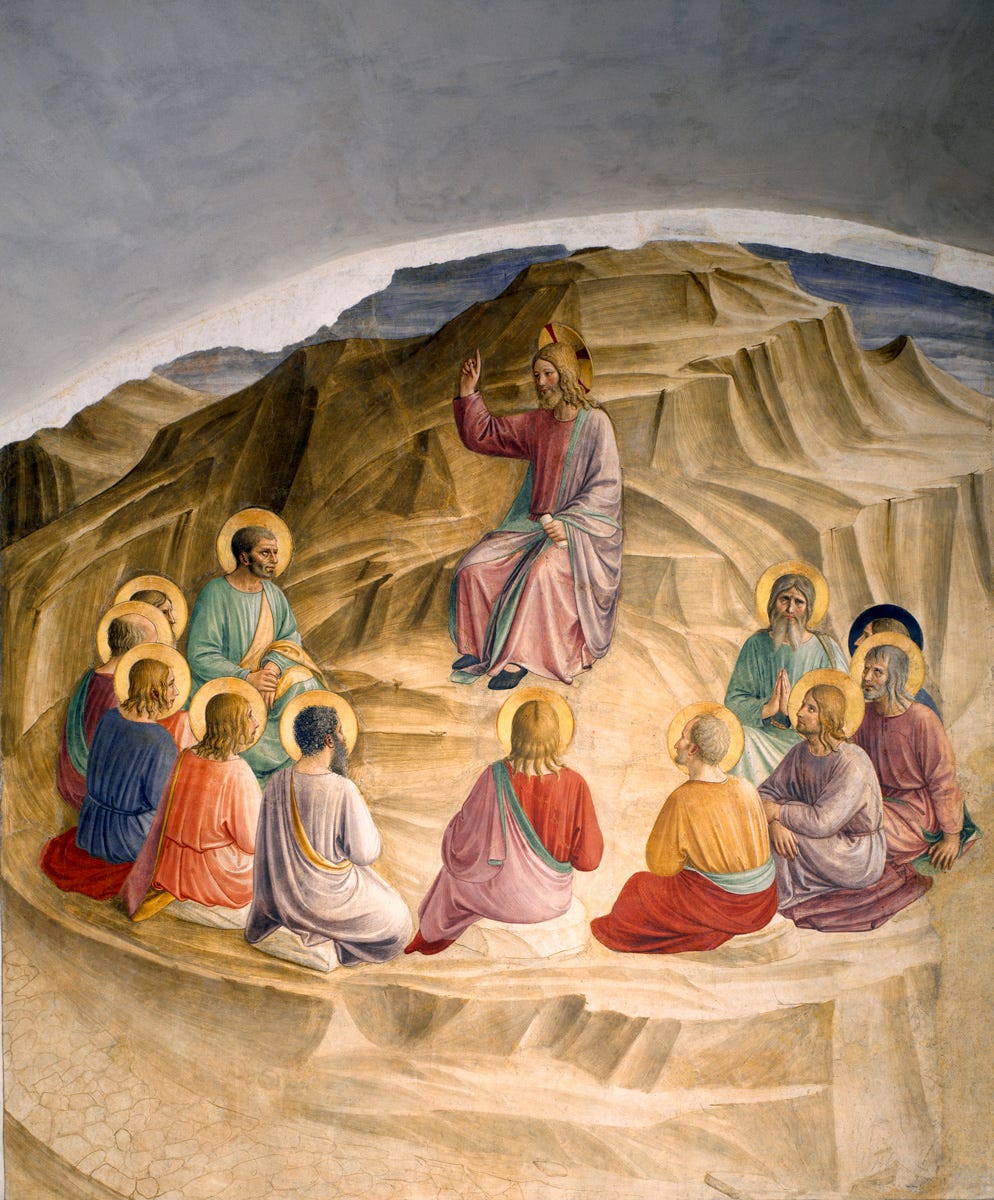
This is the God Jesus is describing in the Sermon on the Mount: the one who makes his sun rise on the bad and the good, and causes rain to fall on the just and the unjust. Ahab is the bad. He is the unjust. And the sun rose on him anyway. And when he put on sackcloth - inadequately, incompletely, barely - the God who sends rain on the unjust received even that.
Jesus says: “You have heard that it was said, You shall love your neighbor and hate your enemy. But I say to you, love your enemies and pray for those who persecute you.”
The structure of the command is important. Jesus is not adding a heroic counsel for the spiritually advanced. He is describing what it means to be a child of the heavenly Father - to act in the world the way the Father acts, which is to say, without calculating the merit of the recipient before extending the gift.
The Father does not check whether the field belongs to a just man before sending rain on it. The sun does not rise later for the wicked. The creation is sustained in its existence by a love that does not first verify that the creature deserves sustaining. To love your enemy is not to achieve a height of moral heroism - it is to begin to imitate, at the creaturely level, the most basic characteristic of the God in whose image you were made.
Jerome, in his commentary on this passage, pushes back against those who treat the command as impossible: “Many measuring the commandments of God by their own weakness, not by the strength of the saints, hold these commands for impossible.”1 The impossibility, he suggests, is an accusation against the giver of the command, not an honest assessment of what grace can do in a person. The same sun that rose on Ahab can rise in us.
Aquinas, commenting on “Be perfect as your heavenly Father is perfect,” identifies the teleios - the Greek word translated “perfect” - with the perfection of charity: the love that has reached its proper end, which is God himself, and which therefore loves as God loves, without remainder, without exception.2 The perfection is not moral flawlessness. It is the completion of a love that has been ordered all the way to its source, and which therefore flows back from that source without checking credentials at the door.
Remigius makes the connection explicit: “Because the utmost perfection of love cannot go beyond the love of enemies, therefore as soon as the Lord has bid us love our enemies, He proceeds, ‘Be ye then perfect.’”3 The love of enemies is not one application of the command to be perfect. It is the definition of it. The sun that rises on the bad and the good is the image of a love that has arrived at its completion.
This week the country stands in the days after the national consecration to the Sacred Heart. It is fitting that the readings place before us this particular image of the Father - the one whose sun rises without discrimination, whose rain falls on the unjust, who received even Ahab’s sackcloth as something worth responding to.
The Heart of Christ is the Heart of this Father made flesh. The love that poured itself out on the cross did not first consult a list of the deserving. It was given to the unjust, for the unjust, while we were yet sinners - which is to say, in the condition of Ahab, in the condition of the enemy. To be consecrated to that Heart is to be formed by that love. And to be formed by that love is, slowly, over years of sackcloth and grace, to begin to let the sun rise on people we would rather leave in the dark.
The hardest application of this command is rarely geopolitical. It is domestic.
The enemy Jesus is asking about is almost never an abstract distant adversary. It is the person who wronged you in a way that still comes up when you try to pray. The family member who took what was yours. The colleague who arranged your undoing and went about subdued afterward, offering the smallest possible gesture of regret. The neighbor who has made your life difficult for years and shows no sign of changing.
Pray for those who persecute you. Not tolerate them. Not manage them from a safe distance. Pray for them - which means bringing them before the God who makes the sun rise on them anyway, and asking him to do for them what he is trying to do for you.
Augustine, reflecting on this passage, observed that the love of enemies overflows from the joy of the persecuted - that the person who has been given enough of the Father’s love will find that it does not stop at the boundary of the self but spills over, the way rain falls without checking where the property lines are.4 The household that prays together, that brings its enemies before God by name, is practicing this overflow. Not always feeling it. Not always managing it. But practicing the gesture - which, as Ahab reminds us, is something God receives.
The sun rises on the bad and the good, on the just and the unjust, on the vineyard-stealers and the vineyard-keepers alike. This is not an injustice. It is the most demanding thing God has ever asked of us: to become children of a Father whose love we cannot outrun, even when we try.
Domus Formation offers tracks of daily prayer and formation for families, men, women, teens, and those in the second half of life. The first school of faith is the home, and every member of it deserves to be formed. WeAreDomus.com
If Catholic fiction that takes the Communion of Saints seriously - as doctrine, not sentiment - is what you are looking for, I am writing two things. Lux Perpetua is a serial novel publishing weekly in two tracks, set in Alton, Illinois, at the edge of the Mississippi - a story of custody and fidelity and a flame passed forward across centuries. And Two Lamps is a weekly short story on Substack, each one braiding two saints from different centuries into a single imagined meeting. Both are for the kind of reader who believes the imagination is also a faculty of faith.
Deacon Michael Halbrook is husband to Suzanne, father of four sons, and a permanent deacon of the Diocese of Springfield in Illinois. He serves at St. Elizabeth Parish in Granite City. He is the founder of Domus Formation, a collection of Catholic prayer and formation resources for every stage of life, and he writes at DeaconMichael.net.
Jerome, Commentary on Matthew 5:43-48; cited in Thomas Aquinas, Catena Aurea on Matthew 5.
Thomas Aquinas, Commentary on the Gospel of Matthew, 5.12.553; cf. Summa Theologiae II-II, q. 184, a. 1-2.
Remigius of Auxerre, cited in Thomas Aquinas, Catena Aurea on Matthew 5:48.
Augustine, De Sermone Domini in Monte, I.1; cf. the interpretation of teleios in Ad Fontes journal (2025), citing Augustine’s reading of the Beatitudes and the love of enemies as culminating in Pentecostal joy.