
He Got Up
Tuesday of the Fifth Week of Easter | Acts 14:19-28 | Psalm 145 | John 14:27-31a

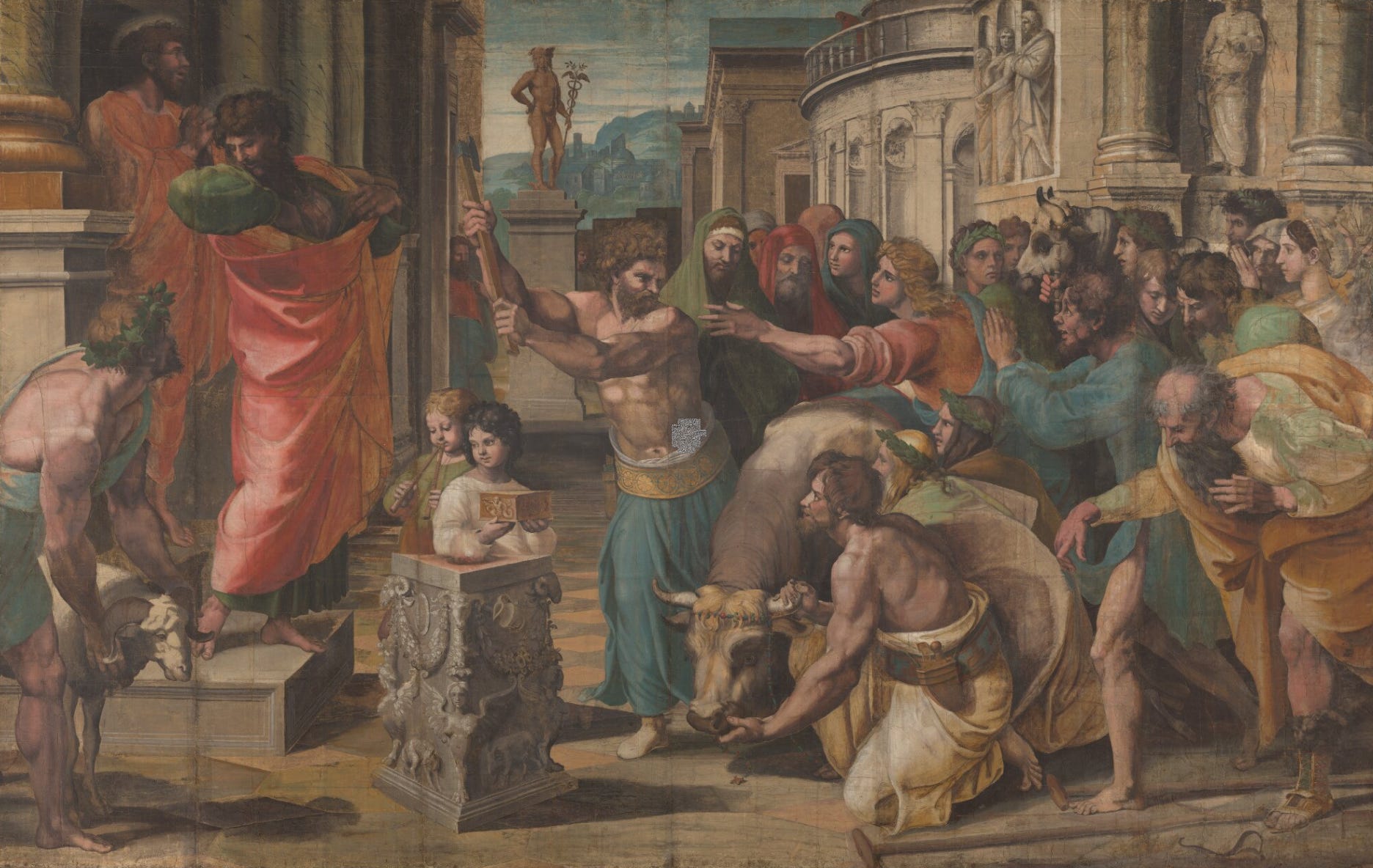
They stoned him and dragged him outside the city, supposing that he was dead.
Luke tells it plainly, without drama. Jews from Antioch and Iconium had arrived, won over the crowds, and done what crowds can be won over to do. Paul was left outside the walls, in the dust, for dead. The disciples gathered around him.
And he got up.
He went back into the city. The next day he left with Barnabas for Derbe.
Those who have been following Acts through this Easter season will feel the weight of that scene. We watched Paul - then Saul - stand at the stoning of Stephen, holding the cloaks of the killers, giving his wholehearted approval. We watched Barnabas retrieve him from Tarsus and bring him to Antioch. We watched the two of them teach together for a year in the community that Stephen’s death had helped scatter into being. And now Paul himself has been stoned and dragged outside a city and left for dead.
Luke intends the parallel. He has been building toward it.
What happens to Paul outside Lystra is not a miraculous escape. It is participation in the same paschal mystery that claimed Stephen - the same dragging toward death, the same threshold crossed. The difference is not that Paul is luckier or tougher. It is that on this day, he rises. Stephen died and was received by the Son of Man standing to welcome him. Paul gets up from the stones and walks back through the city gate. Both men have passed through the same doorway. Neither one is finally stopped.
What Paul does next is worth sitting with.
He and Barnabas retrace their steps - back through Lystra, Iconium, and Antioch, the very cities where they had been threatened and driven out and, in Paul’s case, stoned. They do not send a letter. They go back in person, to the communities most recently formed in the places most recently hostile, and they strengthen them. St. John Chrysostom, in his homily on this passage, marvels at exactly this: that Paul gave way to his persecutors while their passions were roused, but when they had cooled, he returned - going back into the city not to settle scores but to be a benefactor to those who had wronged him.1
And to those communities, Paul and Barnabas say this:
“It is necessary for us to undergo many hardships to enter the Kingdom of God.”
The Greek dei - it is necessary, it must be so - is the same word used of the passion itself. The Son of Man must suffer. Aquinas, treating this necessity carefully in the Summa, distinguishes it from compulsion: Christ did not suffer under any external force, nor was God constrained by any necessity outside himself. The necessity is rather what Aquinas calls necessity of end - given the end God freely chose, the passion was the fittingly necessary means.2 Paul uses the word in the same sense. The Kingdom has a shape. That shape is cross-shaped by divine wisdom, not divine compulsion. And the path into it runs through, not around, the hard things.
This is a remarkably countercultural thing to say to a community of new believers. It is also, perhaps, exactly what they needed to hear from a man who had just been stoned in their city and walked back in. The testimony of life precedes the teaching. He can say it is necessary because he has just lived it.
Jesus, in the farewell discourse, says something that belongs alongside Paul’s words: “Peace I leave with you; my peace I give to you. Not as the world gives do I give it to you.”
Augustine, in his tractates on John, draws out a distinction that is easy to miss: Christ leaves us a peace here - a peace for the life of the Church in time, for mutual charity and the bearing of one another’s burdens - and will give us his own peace there, where dissension is no longer possible.3 The two are not false peace versus real peace, but present peace and fullness of peace - both genuine gifts, both from the same giver, belonging to different moments in the same journey. What Paul carries back through the gates of Lystra is the first kind: a peace given for the road, in the middle of hardship, before the destination is reached. It is not the peace of a man who has avoided the stones. It is the peace of a man who has passed through them and found that the ruler of the world, for all his noise, has no final power over the one who belongs to God.
“Do not let your hearts be troubled or afraid.” This is not a command to feel differently. It is a declaration about reality - about whose hands hold the outcome.
Paul and Barnabas end the journey by returning to Antioch, the church that sent them out, and they gather the community together and report “what God had done with them and how he had opened the door of faith to the Gentiles.” The return is testimonial. The suffering becomes a story. The hardship is not erased or minimized - they have just finished telling new disciples that it is necessary - but it is placed within a larger account of what God was doing through it.
This is a pattern worth naming for the domestic church. The household that has passed through difficulty - illness, estrangement, grief, failure, the long patience of a hard season - and returned to tell the story of what God did in it is doing exactly what Paul and Barnabas do in Antioch. Not performing resilience. Not pretending the stones didn’t hurt, but gathering the people they love and saying: Here is what God did with this. Here is where the door opened.
The household is also, sometimes, called to go back - to return to the hard conversation that was left unfinished, the relationship that frayed, the person who is still in the city where the stoning happened. Paul does not manage the difficult communities from a safe distance. He goes back through Lystra. The domestic church is often called to the same kind of return - not because it is easy, but because the people there need someone to strengthen them, and because it is necessary.
He got up and entered the city.
That sentence is available to us too.
Domus Formation has built the & Altar app to bring daily Catholic prayer and formation into the rhythms of the household - with tracks for families, men, women, teens, and those in the second half of life. Because the first school of faith is the home, and every member of it deserves to be formed.
If the idea of a long story passed forward across centuries - of custody and fidelity and a flame that refuses to go out - resonates with you, I am writing it. Lux Perpetua is a serial novel publishing weekly: a free Monday chapter and a paid Thursday chapter, set in Alton, Illinois, at the edge of the Mississippi. The first chapters are live. Free readers are welcome. LuxPerpetua.net
Deacon Michael Halbrook is husband to Suzanne, father of four sons, and a permanent deacon of the Diocese of Springfield in Illinois. He serves at St. Elizabeth Parish in Granite City. He is the founder of Domus Formation, a collection of Catholic prayer and formation resources for every stage of life, and he writes at DeaconMichael.net.
John Chrysostom, Homilies on the Acts of the Apostles, Homily 31.
Thomas Aquinas, Summa Theologiae III, q. 46, a. 1. Aquinas distinguishes the necessity of Christ’s passion as necessity of end - not compulsion or absolute necessity, but the fittingly necessary means given the end God freely willed for our redemption.
Augustine of Hippo, Tractates on the Gospel of John, Tractate 77.
Excellent, thank you