

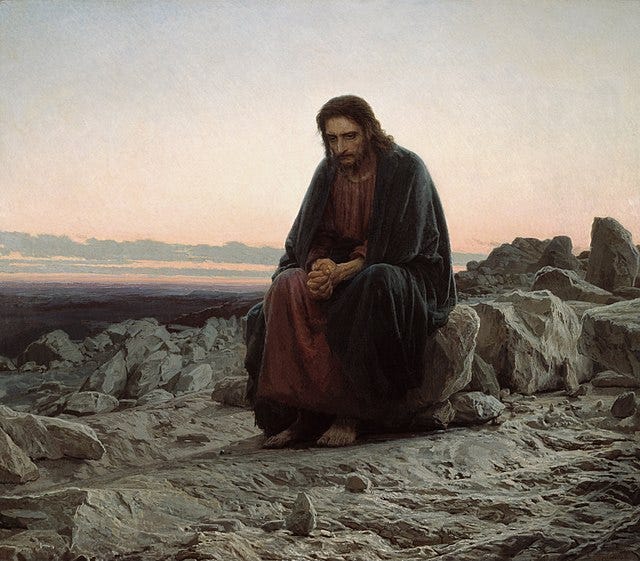
1 Kings 19:9-13
9 And when he was come thither, he abode in a cave: and behold the word of the Lord came unto him, and he said to him: What dost thou here, Elias? 10 And he answered: With zeal have I been zealous for the Lord God of hosts: for the children of Israel have forsaken thy covenant: they have thrown down thy altars, they have slain thy prophets with the sword, and I alone am left, and they seek my life to take it away.
11 And he said to him: Go forth, and stand upon the mount before the Lord: and behold the Lord passeth, and a great and strong wind before the Lord over throwing the mountains, and breaking the rocks in pieces: the Lord is not in the wind, and after the wind an earthquake: the Lord is not in the earthquake. 12 And after the earthquake a fire: the Lord is not in the fire, and after the fire a whistling of a gentle air. 13 And when Elias heard it, he covered his face with his mantle, and coming forth stood in the entering in of the cave
The Douay Rheims explains:
[8] “In the strength of that food”: This bread, with which Elias was fed in the wilderness, was a figure of the bread of life which we receive in the blessed sacrament; by the strength of which we are to be supported in our journey through the wilderness of this world till we come to the true mountain of God, and his vision in a happy eternity.
[10] “I alone am left”: Viz., of the prophets in the kingdom of Israel, or of the ten tribes; for in the kingdom of Juda religion was at that time in a very flourishing condition under the kings Asa and Josaphat. And even in Israel there remained several prophets, though not then known to Elias. See chap. 20. 13, 28, 35.
More modern Bibles and the Douay Rheims name and number books and chapters differently in certain places. In the Douay Rheims, you will find today’s first reading as 3rd Book of Kings, chapter 19. That isn’t very important. What is important is that God speaks to us through a quiet, gentle voice. While silence is important to hear God, Saint Teresa of Avila wrote:
Some books advise that as a preparation for hearing what our Lord may say to us we should keep our minds at rest, waiting to see what He will work in our souls.‘ But unless His Majesty has begun to suspend our faculties, I cannot understand how we are to stop thinking, without doing ourselves more harm than good. This point has been much debated by those learned in spiritual matters; I confess my want of humility in having been unable to yield to their opinion.
I believe that human efforts avail nothing in these matters, which His Majesty appears to reserve to Himself, setting this limit to our powers. In many other things, such as penances, good works, and prayers, with His aid we can help ourselves as far as human weakness will allow. The second reason is, that these interior operations being sweet and peaceful,’ any painful effort does us more harm than good. By “ painful effort “ I mean any forcible restraint we place on ourselves, such as holding our breath.‘ We should rather abandon our souls in to the hands of God, leaving Him to do as He chooses with us, as far as possible forgetting all self-interest and resigning ourselves entirely to His will. The third reason is, that the very effort to think of nothing excites our imagination the more. The fourth is, because we render God the most true and acceptable service by caring only for His honour and glory and forgetting ourselves, our advantages, comfort, and happiness. How can we be self-oblivious, while keeping ourselves under such strict control that we are afraid to move, or even to think, or to leave our minds enough liberty to desire God’s greater glory and to rejoice in the glory which He possesses? When His Majesty wishes the mind to rest from working He employs it in another manner, giving it a light and knowledge far above any obtainable by its own efforts and absorbing it entirely into Himself. Then, though it knows not how, it is filled with wisdom such as it could never gain for itself by striving to suspend the thoughts. God gave us faculties for our use; each of them will receive its proper reward. Then do not let us try to charm them to sleep, but permit them to do their work until divinely called to something higher.
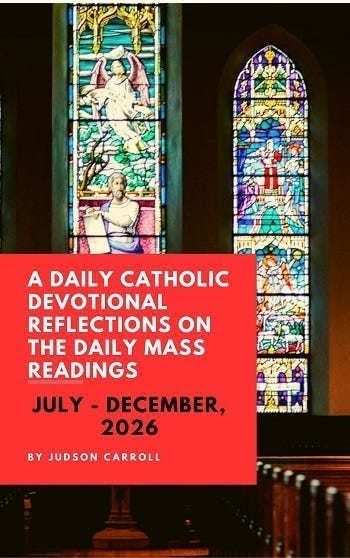
Judson Carroll is the author of several books, including his newest, A Daily Catholic Devotional, Reflections on the Daily Mass Readings July - December, 2026 It is Available in paperback on Amazon: https://www.amazon.com/dp/B0GRGY1D15
A Daily Catholic Devotional, Reflections on the Daily Mass Readings January - June, 2026 It is also available in paperback on Amazon: https://www.amazon.com/dp/B0GDK16N45
and
Confirmation, an Autobiography of Faith: https://www.amazon.com/dp/B0C47Q1JNK
His podcast is The Uncensored Catholic https://www.spreaker.com/show/the-uncensored-catholic