

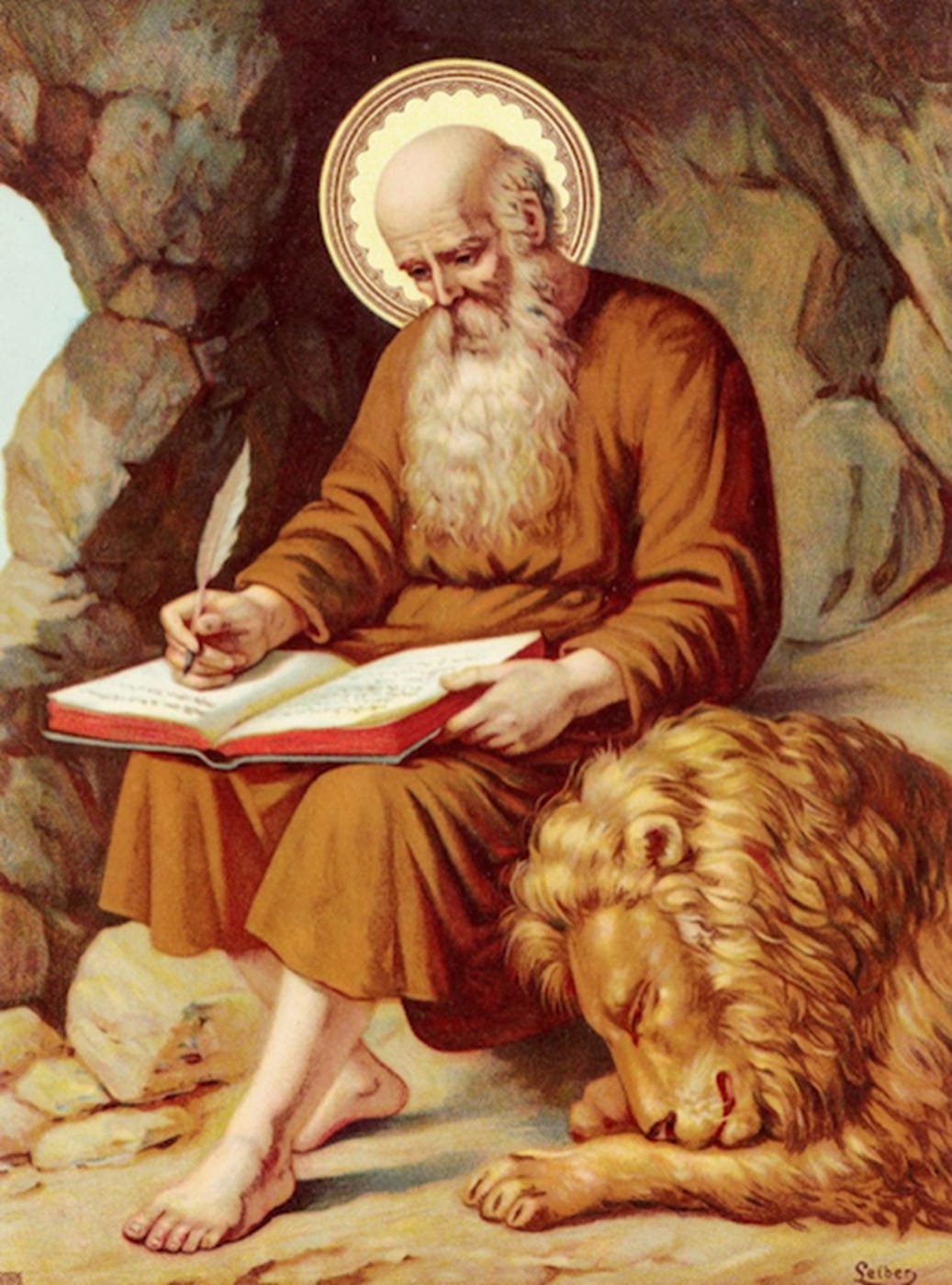
2 Timothy 2:8-15
8 Be mindful that the Lord Jesus Christ is risen again from the dead, of the seed of David, according to my gospel. 9 Wherein I labour even unto bands, as an evildoer; but the word of God is not bound. 10 Therefore I endure all things for the sake of the elect, that they also may obtain the salvation, which is in Christ Jesus, with heavenly glory.
11 A faithful saying: for if we be dead with him, we shall live also with him. 12 If we suffer, we shall also reign with him. If we deny him, he will also deny us. 13 If we believe not, he continueth faithful, he can not deny himself. 14 Of these things put them in mind, charging them before the Lord. Contend not in words, for it is to no profit, but to the subverting of the hearers. 15 Carefully study to present thyself approved unto God, a workman that needeth not to be ashamed, rightly handling the word of truth.
I chose to write on the first reading today because it makes an interesting point: “but the word of God is not bound.” It would be easy to gloss over this point, considering that we are reading it in the Bible. Bibles are so common now qs to be almost universal in America. We may read, “the word of God” and think, wow, yeah the Bible has spread throughout the world! But, that is not the intent of this sentence, at all. Nor, is it a reference to Christ, who is the Word of God incarnate. It is specifically in regard to the teachings of Jesus as given to us through the Holy Apostles.
Again, our Lord did not leave us a Bible. He left us a Church authorized to teach in His stead, who gave us the Bible. Recently, a Protestant told me that the Bible is the Word of God (true) and that it is eternal (true) but also that it has been available as the only reliable and authoritative testament to Christianity “to all generations and for all time”.... absolutely false! Saint Francis de Salles gives us a very succinct history:
The Council of Trent gives these books as sacred, divine and canonical: Genesis, Exodus, Leviticus, Numbers, Deuteronomy, Josue, Judges, Ruth, the four Books of Kings, two of Paralipomenon, two of Esdras (a first, and a second which is called of Nehemias), Tobias, Judith, Esther, Job, 150 Psalms of David, Proverbs, Ecclesiastes, the Canticle of Canticles, Wisdom, Ecclesiasticus, Isaias, Jeremias with Baruch, Ezechiel, Daniel, Osee, Joel, Amos, Abdias, Jonas, Micheas, Nahum, Habacuc, Sophonias, Aggeus, Zacharias, Malachy, two of Machabees, first and second; of the New Testament, four Gospels, S. Matthew, S. Mark, S. Luke, S. John, the Acts of the Apostles by S. Luke, fourteen Epistles of S. Paul, to the Romans, two to the Corinthians, to the Galatians, to the Ephesians, to the Philippians, to the Colossians, two to the Thessalonians, two to Timothy, to Titus, to Philemon, to the Hebrews—two of S. Peter, three of S. John, one of S. James, one of S. Jude, and the Apocalypse. The same books were received at the Council of Florence, and long before that, at the third Council of Carthage about 1,200 years ago.
These books are divided into two ranks. For of some, both of the Old and of the New Testament, it was never doubted but that they were sacred and canonical, others there are about whose authority the ancient fathers doubted for a time, but afterward they were placed with those of the first rank.
Those of the first rank in the Old Testament are the five of Moses, Josue, Judges, Ruth, four of Kings, two of Paralipomenon, two of Esdras and Nehemias, Job, 150 Psalms, Proverbs, Ecclesiastes, Canticles, the four greater Prophets, the 12 lesser Prophets. These were formed into the canon by the great synod at which Esdras was present, and to which he was scribe, and no one ever doubted of their authority without being at once considered a heretic, as our learned Genebrard fully proves in his Chronology.2°2 The second rank contains the following: Esther, Baruch, a part of Daniel (the history of Susanna, the Canticle of the Three Children and the history of the death of the dragon in the 14th chapter), Tobias, Judith, Wisdom, Ecclesiasticus, Machabees 1 and 2. And as to these there is a great probability in the opinion of the same Doctor Genebrard2%that in the meeting which was held at Jerusalem to send the 72 interpreters into Egypt, these books, which were not in existence when Esdras made the first canon, were placed on the canon, at least tacitly, because they were sent with the others to be translated, except the Machabees, which were received in another meeting afterward, wherein the preceding were again approved. But however the case may be, as the second canon was not made so authentically as the first, this placing on the canon could not procure them an entire and unquestionable authority among the Jews nor make them equal with the books of the first rank.
Coming to the books of the New Testament, I say that in the same way there are some of the first rank, which have always been acknowledged and received as sacred and canonical. These are the four Gospels, S. Matthew, S. Mark, S. Luke, S. John, all the Epistles of S. Paul except that to the Hebrews, one of S. Peter, one of S. John. Those of the second rank are the Epistle to the Hebrews, that of S. James, the second of S. Peter, the second and third of S. John, that of S. Jude, the 16th chapter of S. Mark, as S. Jerome says, and S. Luke’s history of the bloody sweat of Our Lord in the garden of olives, according to the same S. Jerome; in the eighth chapter of S. John there has been a doubt concerning the history of the woman taken in adultery, or at least some suspect that it has been doubted, and concerning verse seven of the last chapter of S. John’s First Epistle. These are, as far as we know, the books and parts of books concerning which it appears there was anciently some doubt. And these were not of undoubted authority in the Church at first, but as time went on they were at length recognized as the sacred work of the Holy Spirit, and not all at once but at different times. And first, besides those of the first rank, whether of the new or of the Old Testament, about the year 364 there were received at the Council of Laodicea24 (which was afterward approved in the sixth general Council22), the book of Esther, the Epistle of S. James, the Second of S. Peter, the Second and Third of S. John, that of S. Jude, and the Epistle to the Hebrews as the fourteenth of S. Paul. Then some time afterward at the third Council of Carthage2°® (at which S. Augustine assisted, and which was confirmed in the sixth general Council inTrullo), besides those of the second rank just mentioned, there were received into the canon, as of full authority, Tobias, Judith, First and Second Machabees, Wisdom, Ecclesiasticus and the Apocalypse. But of all those of the second rank, the book of Judith was first received and acknowledged as divine, in the first General Council of Nice, as S. Jerome witnesses in his preface to this book. Such is the way in which the two ranks were brought together into one, and ever made of equal authority in the Church of God, but progressively and with succession, as a beautiful morning rising, which little by little lights up our hemisphere.
Thus was drawn up in the Council of Carthage, that same ancient list of the canonical books which has ever since been in the Catholic Church and which was confirmed in the sixth general Council, at the great Council of Florence 160 years ago for the union of the Armenians by the whole Church both Greek and Latin, in our age by the Council of Trent, and which was followed by S. Augustine. Before the Council of Carthage they were not all received as canonical by any decree of the general church. I had almost forgotten to say that you must not therefore make a difficulty against what I have just laid down because Baruch is not quoted by name in the Council of Carthage. For since Baruch was secretary of Jeremias, the book of Baruch was reckoned by the ancients as an accessory or appendix of Jeremias, being comprised under this, as that excellent theologian Bellarmine proves in his Controversies. But it is enough for me to have said thus: my brief outline is not obliged to dwell on every particular. In a word, all these books, whether of first or second rank, with all the parts, are equally certain, sacred and canonical, and are received in the Catholic Church.
In truth, Christians had no Bible for about twice as long as America has been a nation. For centuries after that, Bibles were hand copied and very rare. And, until recently, most people were illiterate. Christians had the word of God as is referenced in today’s first reading. They had the teachings of the Apostles through the Catholic Church. The Bible is wonderful and essential. But, it is not self explanatory. Today, just as was true 2,000 years ago, we need the teaching of the Holy Catholic Church to know the word and the WORD of God.
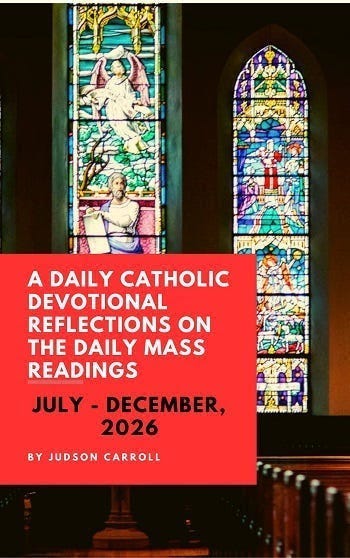
Judson Carroll is the author of several books, including his newest, A Daily Catholic Devotional, Reflections on the Daily Mass Readings July - December, 2026 It is Available in paperback on Amazon: https://www.amazon.com/dp/B0GRGY1D15
A Daily Catholic Devotional, Reflections on the Daily Mass Readings January - June, 2026 It is also available in paperback on Amazon: https://www.amazon.com/dp/B0GDK16N45
and
Confirmation, an Autobiography of Faith: https://www.amazon.com/dp/B0C47Q1JNK
His podcast is The Uncensored Catholic https://www.spreaker.com/show/the-uncensored-catholic