

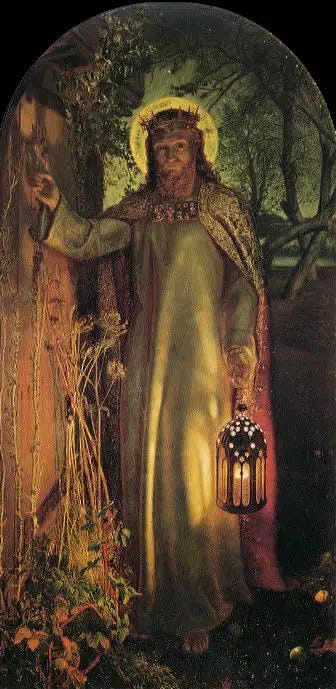
Mark 10:46-52
46 And they came to Jericho: and as he went out of Jericho, with his disciples, and a very great multitude, Bartimeus the blind man, the son of Timeus, sat by the way side begging. 47 Who when he had heard, that it was Jesus of Nazareth, began to cry out, and to say: Jesus son of David, have mercy on me. 48 And many rebuked him, that he might hold his peace; but he cried a great deal the more: Son of David, have mercy on me. 49 And Jesus, standing still, commanded him to be called. And they call the blind man, saying to him: Be of better comfort: arise, he calleth thee. 50 Who casting off his garment leaped up, and came to him.
51 And Jesus answering, said to him: What wilt thou that I should do to thee? And the blind man said to him: Rabboni, that I may see. 52 And Jesus saith to him: Go thy way, thy faith hath made thee whole. And immediately he saw, and followed him in the way.
A couple of years ago, I heard an interesting homily on this verse. Fr. Daniel Papineau pointed out that there are many forms of blindness. In the case of the blind man in today’s Gospel, we must assume that he suffered from physical blindness. Our Lord healed several blind men in the Bible though, so perhaps we should think about the issue of blindness. Another form of blindness is spiritual blindness. When we are spiritually blind, we do not see the power of God in our life or the dangers of sin and evil. Much of our culture is spiritually blind, and we may also say morally blind – denying both the goodness of Christian teaching and the wrongness of sin.
But, we may also be blind to situations in our lives. We may not see our own faults. We also may not see others for who they truly are. If we are blind to our own faults, we hurt others and ourselves. We also fail to confess many sins because we are either not aware of them or diminish their gravity. How often do we make excuses, saying, “well, it may be wrong, but that is just who I am” or, “its not as bad as what others do.” Many are in dysfunctional relationships and excuse either the bad behavior of another or their bad influence. We do neither ourselves nor the other any favors by turning a blind eye to abuse or negative influence.
These types of spiritual blindness can be hard to address. Unlike the physically blind man in today’s Gospel, we may not wish to be healed. We may not call out for God’s help, because having our eyes opened to the realities of our lives will be painful. But, if we are do as God asks, we must. Let us pray that we may see clearly our flaws, those in our relationships, our culture, politics and even our Church. We must make a thorough examination of conscience each evening and pray for God’s help. Frankly, we will begin to see a lot of things we would rather not. But, the problem must be identified before it can be fixed. A poet once said that the first step in honest writing, and not allowing politics, propaganda or sentiment to affect one’s work was, “to see what you see.” Honestly, that is harder than it sounds.
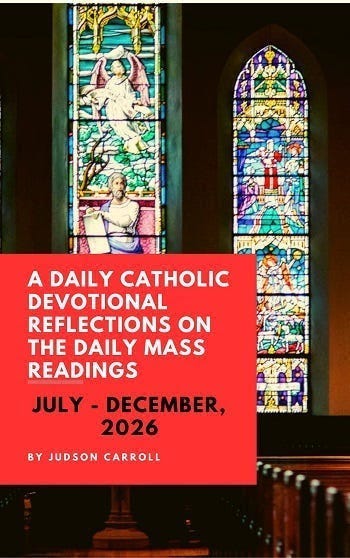
Judson Carroll is the author of several books, including his newest, A Daily Catholic Devotional, Reflections on the Daily Mass Readings July - December, 2026 It is Available in paperback on Amazon: https://www.amazon.com/dp/B0GRGY1D15
A Daily Catholic Devotional, Reflections on the Daily Mass Readings January - June, 2026 It is also available in paperback on Amazon: https://www.amazon.com/dp/B0GDK16N45
and
Confirmation, an Autobiography of Faith: https://www.amazon.com/dp/B0C47Q1JNK
His podcast is The Uncensored Catholic https://www.spreaker.com/show/the-uncensored-catholic
So true, so simple and yet so difficult for most of us.
Excellent, thank you Judson