

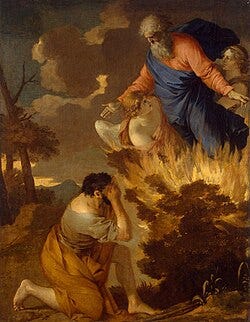
“And as for the dead being raised, have you not read in the book of Moses, in the passage about the bush, how God said to him, ‘I am the God of Abraham, and the God of Isaac, and the God of Jacob’? He is not God of the dead, but of the living; you are quite wrong.” Mk 12:26–27.
Today’s Gospel bears witness to the Communion of Saints. Our Lord is questioned by the Sadducees, who were a sect of Jewish leaders who specifically denied the resurrection of the dead. In an attempt to prove their claims contra the Pharisees, they came up with an elaborate scenario in which a woman marries a man and his six brothers, in succession, as each one died according to the Law of Moses.1 “In the resurrection, whose wife will she be? For seven had her as wife.”2
The Sadducees are very smug in their thought that they trapped Jesus, and by extension, the Pharisees. Our Lord clarifies two very important truths:
“For when they rise from the dead, they neither marry nor are given in marriage, but are like angels in heaven.” Mark 12:25.
“He is not a God of the dead, but of the living...” Mark 12:27.
The first of these truths gives us an understanding of the nature of marriage as a sacrament. Marriage is an earthly institution. While it certainly is a preparation and foretaste of heaven, it is not meant to cross the threshold of death. The gift of self found within the marital bond is a foreshadowing of the gift of self that the beatified soul has with the Trinitarian God. Just as a husband and wife give themselves, without reserve, to one another, we find a glimpse of the pouring of the essence of God into the beatified soul in heaven. It is this absolute unity with God that gives reason why the marital bond ends at death. The beatified soul must be free to give itself entirely to God and to be filled by Him alone. Thus, the marital vows are kept “until death do us part.”
The second pertains to the actual resurrection of the body, in particular, the Communion of Saints. Our Lord cites the Theophany of the burning bush when God speaks to Moses and identifies Himself as “The God of Abraham, and the God of Isaac, and the God of Jacob.”3 Our Lord uses the Books of Moses to show the Sadducees that their belief is wrong. Abraham, Isaac, and Jacob are not dead but are very much living! They are alive in God, awaiting the resurrection of the body at the end of time.4 Our Lord Himself is the one who puts forward this exegetical interpretation. By extension, this applies to all those who have departed this life in friendship with God. They are not dead but living! Thus, the saints in heaven, by the power and providence of God, are there to bear witness to the coming resurrection. It is here that we find the tradition of invocation of the saints.
These two truths fall among two equally important claims as well:
“...have you not read in the Book of Moses…” Mark 12:26
“...you are quite wrong.” Mark 12:27.
I have always placed a lot of emphasis on this first line. Have you not read? This is a question that is asked in a fair bit of irony. This is because they have very clearly read, but they have not understood. These are two very different things. The Sadducees and Pharisees were among the most educated and well-read groups in 1st-century Jewish society. And yet, both groups missed so much because they read without understanding.
Finally, Our Lord very plainly tells them, You are quite wrong. Not only were they wrong about the nature of marriage, but they were also wrong about the resurrection of the flesh. More than that, and I think this is where Our Lord emphasises the modifier of quite wrong. They were wrong about the very nature of God and His desire for mankind. The very nature of God is life. To deny the resurrection, the immortality of the soul, eternal life, the intercession of the saints, etc., is to deny the very nature of God Himself as the sustainer of all existence. It is to deny God as eternal life itself. Those who depart this life in a state of grace move on to a participated eternity and thus are incorporated into the divine life of God.
We do not want to become modern-day Sadducees and deny these essential truths of the faith. We may read, but do we truly understand? Our God is not a God of the dead. Those in heaven are not silent, sleeping, detached souls who have no connection to us. Our God is a God of the living. His saints live and act through Him. He has providentially ordered each prayer by the saints to be efficacious for those who ask for it.
He is not a God of the dead but of the living.
For more from Dr. McGovern, visit his Substack at A Thomist, Dedicated to the Theological tradition of St. Thomas Aquinas. Exploring Thomas’ Spiritual Theology and topics in Christology and Mariology.
Cf. Deuteronomy 25:5-6.
Mark 12:23.
Cf. Exodus 3:6.
Cf. Isaiah 26:19.
Beautifully explained. Thank you.
Oh, thank you!