
God Bless America
Saturday, July 4th Readings Reflection: Saturday of the Thirteenth Week in Ordinary Time

Today is the 250th anniversary of the adoption of the Declaration of Independence, marking the anniversary of the United States of America as a free nation under God, “with liberty and justice for all.” Independence Day is of such great importance that the USCCB permits parishes in America to choose from among various Votive Masses for civil needs and nations. On Independence Day, Catholics across America pray for our country, and on this historic anniversary, it is worth reflecting on what this day means for us as Catholics in America.
In his Summa theologiae (II-II, q. 101, a. 1), St. Thomas Aquinas teaches that patriotism is part of the virtue of piety. He writes that “man is debtor chiefly to his parents and his country, after God.” We know that honoring our parents is commanded by the Fourth Commandment, but this commandment also requires us to respect all lawful superiors, including legitimate civil authorities. Just as our parents have given us physical “birth and nourishment,” so too has our government, St. Thomas explains, and we are indebted to our country for its efforts to preserve the common good, which benefits us as members of society and citizens of the country.
St. Thomas certainly recognizes that no earthly government is perfect, for all human leaders are subject to sin as part of their fallen human nature; he is very clear that obedience to a government does not obligate citizens to obey an unjust law, which he argues is no law at all (ST, I-II, q. 96, a. 4). However, this does not change St. Thomas’s view on patriotism as required in justice, particularly by means of charity toward one’s fellow citizens.
The American Declaration of Independence is founded on many principles that St. Thomas himself used throughout his philosophical and theological works. The Declaration of Independence invokes the “Laws of Nature and of Nature’s God,” which as Catholics we understand to be the natural law and the divine law. In creating the universe, God established a certain moral code that is written in the hearts of all men, whereby they can intuitively understand a basic sense of right and wrong by virtue of their human intellect.
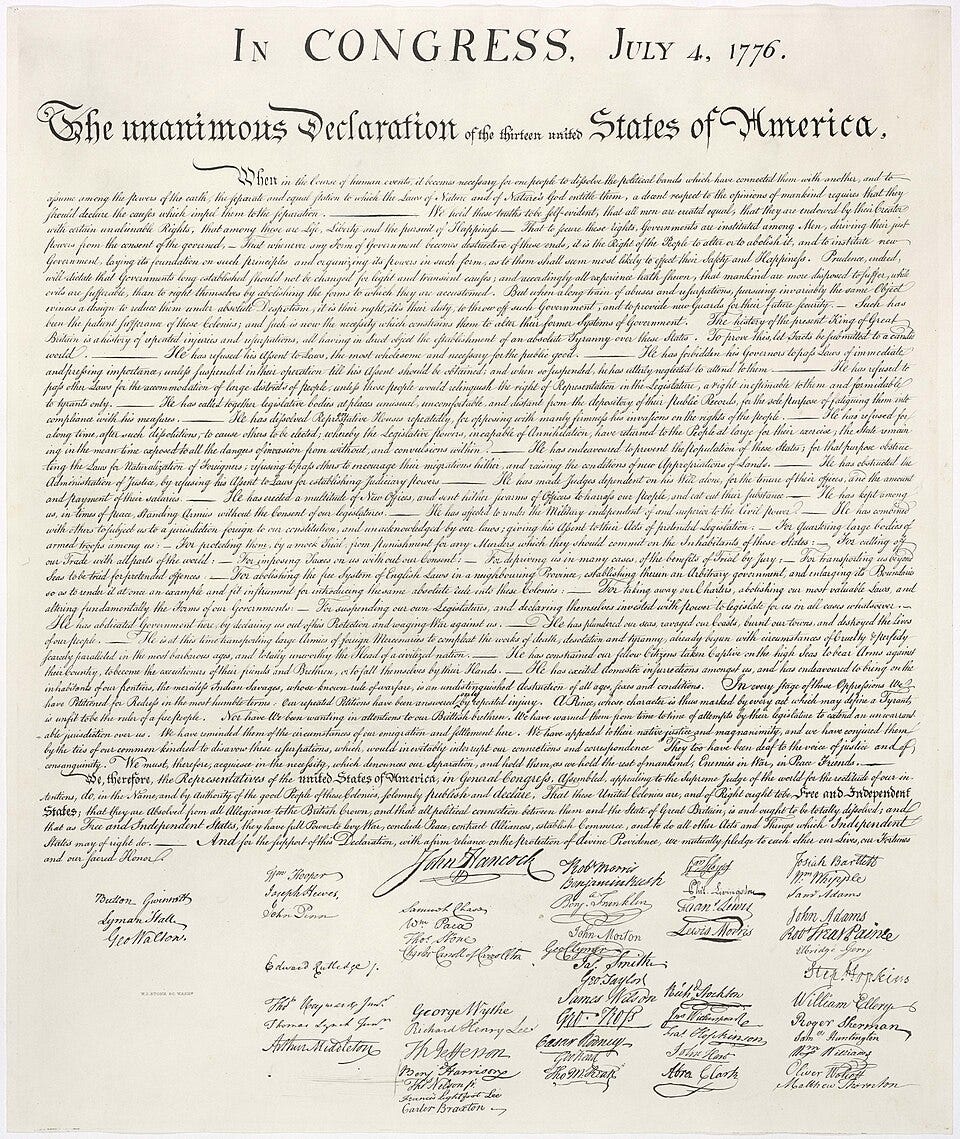
The rights to “Life, Liberty, and the pursuit of Happiness,” as articulated in the Declaration of Independence, also find their echoes in St. Thomas. In defending man’s right to life, St. Thomas writes that “life is God’s gift to man, and is subject to His power” (ST, II-II, q. 64, a. 5). Throughout his writings, St. Thomas identifies liberty as the ability to choose the good (see, for example, ST, 83, a. 2, ad. 3). When this ability is abused and used to choose evil, the person is no longer exercising his liberty but rather becoming a slave to his base desires. Since liberty is the ability to choose the good, it follows—as St. Thomas Aquinas explains in numerous places—that civil laws aid citizens in becoming virtuous by prohibiting them from choosing evil (see, for example, ST, I-II, q. 96, a. 2).
St. Thomas builds upon the medieval Christian philosophical tradition in defining happiness as the attainment of the good (see ST, I, q. 26, a. 1). The ultimate good, of course, is God, without Whom our hearts can never fully be satisfied. As seen in the Declaration of Independence, the United States of America was founded on Christian principles that sought to establish a nation that respects both natural and divine laws in order to help its citizens attain happiness by the ability to choose the good in their lives.
Two hundred fifty years ago, Catholics fought in the American War for Independence in order to safeguard these freedoms, and today, two hundred fifty years later, Catholics continue to live in this great nation and enjoy the rights and freedoms for which our Founding Fathers fought. While no nation is perfect and immune to the effects of sin and other challenges that exist in a fallen world, we should truly be proud of our country and grateful for the blessings that we experience as citizens of the United States of America.
On this the 250th anniversary of the United States of America, may we offer to God prayers of gratitude for the many blessings He has granted us in the freedom of our country—including the freedom to practice our Catholic Faith—as well as prayers of petition, that He would continue to bless our country and her citizens and safeguard the freedoms that were so fundamental to our nation’s founding. May God bless America on this her 250th anniversary.
Notice which signer included his address....
Very nicely explained. Thank you.