

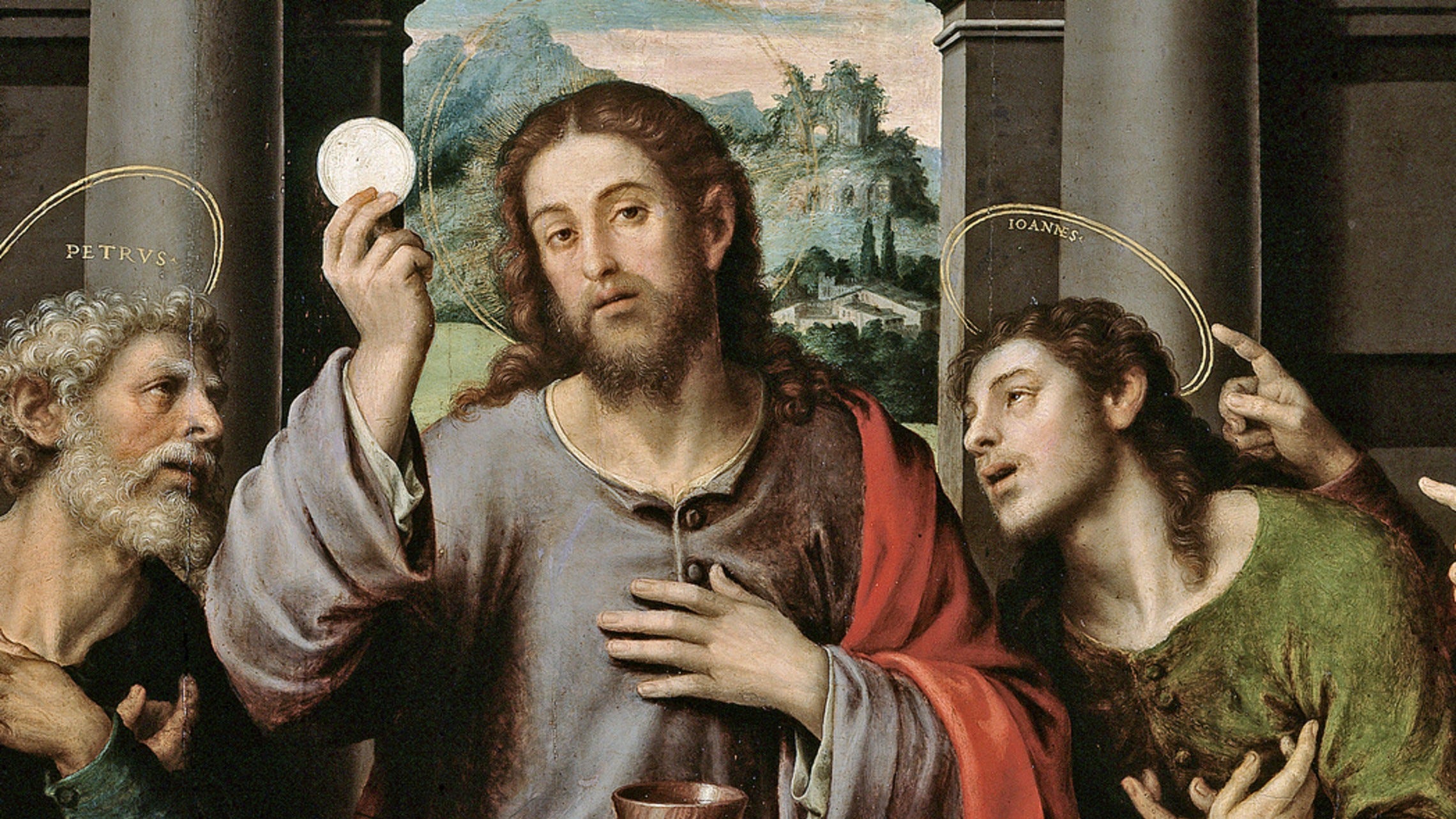
“Jesus said to them, ‘I am the bread of life; he who comes to me shall not hunger, and he who believes in me shall never thirst. But I said to you that you have seen me and yet do not believe. All that the Father gives me will come to me; and him who comes to me I will not cast out. For I have come down from heaven, not to do my own will, but the will of him who sent me; and this is the will of him who sent me, that I should lose nothing of all that he has given me, but raise it up at the last day. For this is the will of my Father, that every one who sees the Son and believes in him should have eternal life; and I will raise him up at the last day.’” John 6:35–40.
As is customary in the weeks of Easter, we are given the great Bread of Life discourse from the Gospel of John. This discourse contains what I believe to be the most important verses regarding the Eucharist that can be found in all of Scripture.
In today’s Gospel, Our Lord speaks of the Eucharist as the Bread of Life. This is not regarding earthly life, i.e., the sustenance of our normal meal cadence. This is a food that endures to eternal life.1 Christ specifically links the reception of the Holy Eucharist to eternal life and the resurrection at the end of time. It is here that we find a very important distinction that Jesus makes all through the Bread of Life discourse:
There is a difference between normal food and the Eucharist.
Truly, this is the fundamental difference between viewing the Eucharist as symbolic and having the faith to see the true presence of Christ, as St. Thomas says, “The presence of Christ’s true body and blood in this sacrament cannot be detected by sense, nor understanding, but by faith alone, which rests upon Divine authority.”2 We cannot cross that threshold of symbol to true presence without the virtue of faith.
I would argue that reading the Bread of Life discourse eliminates the possibility of a symbolic understanding of the Eucharist, which begins with Our Lord’s distinction found in today’s Gospel. Normal food does not cause eternal life to spring up within the soul of the believer. The food that we consume daily will not cause the resurrection of the body. It is meant only for the daily nutrition that is necessary for our bodies to live on this earth. But Our Lord gives us a different food. It is a food that is given not to fill our bellies, like the multiplication of the loaves was in the beginning of chapter six,3 but to effect the resurrection to eternal life. This is why Our Lord promises eternal life in the midst of this great doctrinal discourse. One follows from the other.
Following this distinction between normal food and the Eucharist, St. Paul speaks in the same way in his First Letter to the Corinthians:
“Whoever, therefore, eats the bread or drinks the cup of the Lord in an unworthy manner will be guilty of profaning the body and blood of the Lord. Let a man examine himself, and so eat of the bread and drink of the cup. For anyone who eats and drinks without discerning, the body eats and drinks judgment upon himself.” 1 Corinthians 11:27–29.
In his instruction to the people of Corinth, St. Paul clearly sets the Eucharist apart from normal food and drink. No one needs to examine themselves when eating normal food. No one needs to worry about whether they are eating normal food in an unworthy manner. These things simply aren’t taken into account, and nor should they be, when one sits down to lunch.
Our Lord and St. Paul are saying the same thing. Our Lord is telling us that we must eat of the Eucharist if we desire eternal life, and St. Paul warns us that taking the Eucharist without discerning the body and in an unworthy manner brings judgment upon oneself. Normal food does not have these two extreme effects:
The ability to give eternal life if received worthily
Or
The ability to bring judgment upon oneself if received unworthily
This is not symbolic language. A symbol cannot do either of these things. A symbol cannot grant eternal life, and a symbol cannot bring judgment upon you. Only something that is efficacious and impacts the soul can do these things. Our Lord is very clear in the Bread of Life discourse as to what He is giving us. He is giving us His flesh and blood as true food and true drink.4 This is what leads St. Thomas to write:
“Some men, accordingly, not paying heed to these things, have contended that Christ’s body and blood are not in this sacrament except as in a sign, a thing to be rejected as heretical, since it is contrary to Christ’s words.”5
Christ has given us the immense gift of Himself in the Eucharist so that when received worthily, this food and drink is efficacious for eternal life. And thus, through reception of the Most Holy Eucharist, He will raise us on the last day.
For more from Dr. McGovern, visit his Substack at A Thomist, Dedicated to the Theological tradition of St. Thomas Aquinas. Exploring Thomas’ Spiritual Theology and topics in Christology and Mariology.
John 6:27.
St. Thomas Aquinas, Summa Theologiae, IIIa q. 75, a. 1.
See John 6:1-15.
Cf. John 6:55.
ST IIIa q. 75, a. 1.
As usual you make the teachings of Christ so clear! Thank you!