
First Called Christians
Tuesday of the Fourth Week of Easter | Acts 11:19-26 | Psalm 87 | John 10:22-30

It begins with a scattering.
The persecution that rose up after Stephen’s death drove the disciples out of Jerusalem - to Phoenicia, Cyprus, Antioch, further than they might otherwise have gone, further than the original mission seemed to require. Luke notes this almost in passing, as though it were an administrative detail: “those who had been scattered by the persecution that arose because of Stephen.” But it is not incidental. The violence that killed Stephen became the wind that carried the Gospel to people it had not yet reached.
Some of the scattered disciples, Cypriots and Cyrenians among them, arrived in Antioch and did something that had not been done before: they spoke of the faith to Greeks. Not to Jews of the diaspora, not to God-fearers at the edge of the synagogue, but to Greeks - Gentiles, outsiders, people with no framework for the covenant and no preparation for the Messiah. “The hand of the Lord was with them,” Luke says, “and a great number who believed turned to the Lord.”
The news reached Jerusalem. The church sent Barnabas to see what was happening.
We met Barnabas two weeks ago in this series - the son of encouragement, the man who sold a field and laid the money at the apostles’ feet. He arrives in Antioch as an investigator of sorts, an emissary from the mother church sent to evaluate a situation that has moved faster than anyone anticipated. What he finds is grace. And his response is not to audit it or to send a cautious report back to Jerusalem. “When he arrived and saw the grace of God, he rejoiced.”
This is the instinct of a man formed by the resurrection. He sees something of God and his first movement is joy. Not suspicion, not procedural caution, not the careful hedging of someone protecting institutional interests. Joy. And from that joy, encouragement: he urged them all to remain faithful to the Lord with firmness of heart.
Then he does the most consequential thing he could have done. He goes to Tarsus to find Saul.
The man who stood at Stephen’s stoning giving his wholehearted approval - suneudokōn, pleased by it - has by this point been converted, commissioned, and sent back to his home city of Tarsus, where he has been for some years in a kind of obscurity. Barnabas goes to find him and brings him to Antioch. For a whole year, the two of them teach together in the community that Stephen’s death helped scatter into being.
The loop closes so quietly that it is easy to miss. The son of encouragement retrieves the man who approved the killing of the first martyr and places him at the heart of the community the martyr’s death created. This is what grace looks like when it has been working for a while.
And then the name.
“It was in Antioch that the disciples were first called Christians.”
The Greek Christianous was almost certainly coined by outsiders - a label applied to this community by the people around them, possibly with mockery, in the way that “Methodist” would be coined mockingly centuries later, or the way any new and distinctive movement attracts a nickname from those watching. But it stuck. And it stuck because something visible was happening. These people were different enough from their surrounding culture that they needed a new word. The name followed the reality.
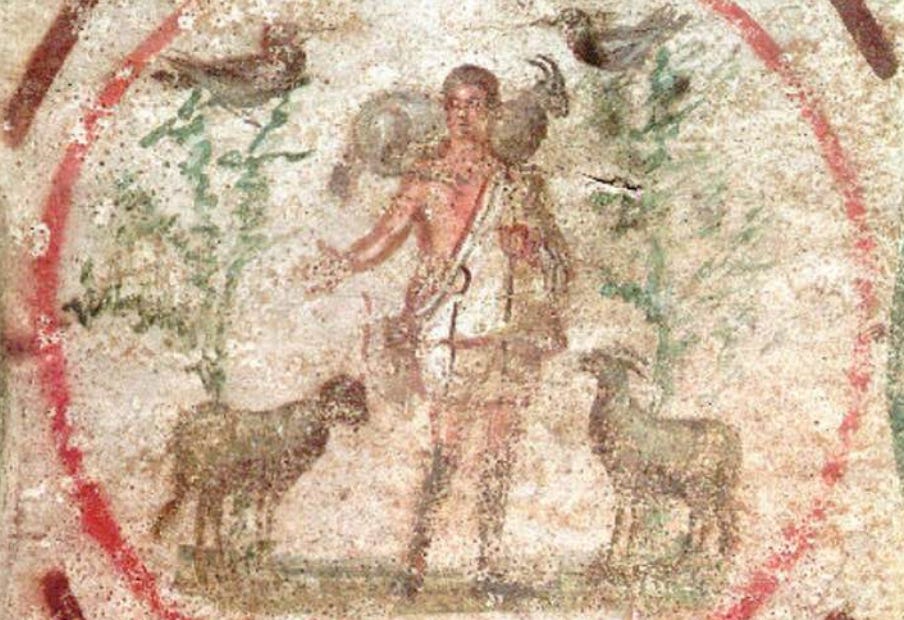
Jesus, in John’s Gospel, is standing in the Portico of Solomon at the Feast of Dedication - winter, the temple colonnade, the crowd pressing in - and they ask him the question they have been circling for some time: “How long will you keep us in suspense? If you are the Christ, tell us plainly.” He tells them what he has already told them: the works testify. But you do not believe, because you are not among my sheep. “My sheep hear my voice; I know them, and they follow me.”
The Antioch community had heard the voice. They had followed. And the people outside them could see something - something distinct enough, something joy-shaped and generous and stubbornly committed - that a new name was required. They did not name themselves. They were named because of what was visible.
This is the domestic question the readings press this week. Not “are you a Christian?” in the sense of formal membership, but “is there something visible?” Would the people outside your household - your neighbors, your colleagues, the extended family who does not share the faith - need a new word for what they see in you? Not a performed religiosity, not a conspicuous piety, but the thing that made people in Antioch reach for a name: a joy at encountering grace, a firmness of heart, a willingness to encourage, an instinct to go find the difficult person and bring them in.
Barnabas did not wait for Saul to find his way back. He went to Tarsus. He looked for him. He brought him home to the community where his gifts would be used and his story would be redeemed. The domestic church does this too - it is often a single relationship, a single person willing to make the trip, that brings someone from the edges into the life of faith. Not a program. A Barnabas.
The sheep hear the voice and follow. The following, over time, becomes visible. The visibility, over time, acquires a name.
What name would the people outside your door give to what they see?
Domus Formation has built the & Altar app to bring daily Catholic prayer and formation into the rhythms of the household — with tracks for families, men, women, teens, and those in the second half of life. Because the first school of faith is the home, and every member of it deserves to be formed.
If the idea of a long story passed forward across centuries - of custody and fidelity and a flame that refuses to go out - resonates with you, I am writing it. Lux Perpetua is a serial novel publishing weekly: a free Monday chapter and a paid Thursday chapter, set in Alton, Illinois, at the edge of the Mississippi. The first chapters are live. Free readers are welcome. LuxPerpetua.net
Deacon Michael Halbrook is husband to Suzanne, father of four sons, and a permanent deacon of the Diocese of Springfield in Illinois. He serves at St. Elizabeth Parish in Granite City. He is the founder of Domus Formation, a collection of Catholic prayer and formation resources for every stage of life, and he writes at DeaconMichael.net.
Most excellent first sentence👏👏