
Extra Ecclesiam Nulla Salus
Gospel Reflection for May 3, 2026, the Fifth Sunday of Easter - John 14:1-12

1 Let not your heart be troubled. You believe in God, believe also in me.
2 In my Father’s house there are many mansions. If not, I would have told you: because I go to prepare a place for you.
3 And if I shall go, and prepare a place for you, I will come again, and will take you to myself; that where I am, you also may be.
4 And whither I go you know, and the way you know.
5 Thomas saith to him: Lord, we know not whither thou goest; and how can we know the way?
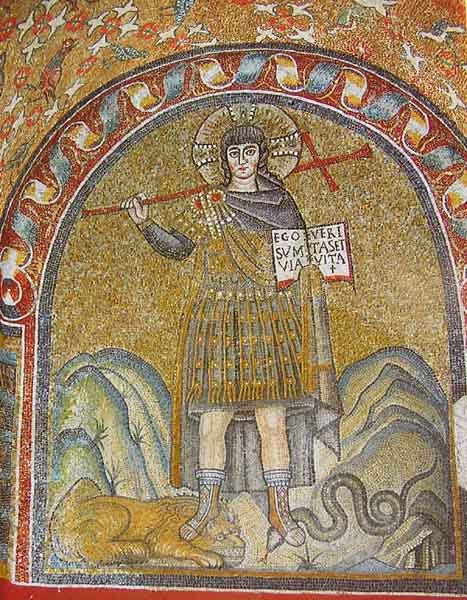
6 Jesus saith to him: I am the way, and the truth, and the life. No man cometh to the Father, but by me.
7 If you had known me, you would without doubt have known my Father also: and from henceforth you shall know him, and you have seen him.
8 Philip saith to him: Lord, shew us the Father, and it is enough for us.
9 Jesus saith to him: Have I been so long a time with you; and have you not known me? Philip, he that seeth me seeth the Father also. How sayest thou, shew us the Father?
10 Do you not believe, that I am in the Father, and the Father in me? The words that I speak to you, I speak not of myself. But the Father who abideth in me, he doth the works.
11 Believe you not that I am in the Father, and the Father in me?
12 Otherwise believe for the very works’ sake. Amen, amen I say to you, he that believeth in me, the works that I do, he also shall do; and greater than these shall he do.
(John 14:1-12 DRA)
In our Gospel reading for this fifth Sunday of Easter, we hear one of Our Lord’s most explicit affirmations of an infallible Catholic dogma, rendered in Latin since the Fourth Lateran Council in 1215 as extra Ecclesiam nulla salus, that is, ‘outside the Church there is no salvation.’ This has been understood differently throughout the centuries and, like all the dogmas of the Church, it was not invented when it was defined by the Magisterium but was taught unanimously by the Fathers in their uncompromising reading of Scripture. The traditional teaching was summarized succinctly by Pope Leo XII in his encyclical Ubi primum §14:
It is impossible for the most true God, who is Truth itself, the best, the wisest Provider, and the Rewarder of good men, to approve all sects who profess false teachings which are often inconsistent with one another and contradictory, and to confer eternal rewards on their members… by divine faith we hold one Lord, one faith, one baptism, and that no other name under heaven is given to men except the name of Jesus Christ of Nazareth in which we must be saved. This is why we profess that there is no salvation outside the Church.
As always, in responding to this, people tend toward one of two extremes, some toward the heresy of Feeneyism, which as my colleague Phillip Hadden wrote last May was condemned by the Holy Office in 1953, because Fr. Feeney taught that only those who are visible, practicing members of the Catholic Church can be saved. Others, however, particularly those influenced by Modernism or by the tacit universalism of Hans Urs Von Balthasar, tend toward the opposite extreme, positing that anyone who simply follows what they think God wants them to do, according to their subjective beliefs about Him and the judgment of their conscience, can and probably will be saved, that God would just apply the sanctifying grace of Christ usually limited to the Sacraments onto their souls.
Both of these extremes miss the mark, but they do so in reaction to two distinct fears: for Feeneyism, the fear of betraying the uniqueness of Christ as our one true Savior, as He clearly states in today’s Gospel and throughout the New Testament, so that the Faith is reduced to a melting pot where all religions are equal paths up the mountain to God a la Oprah Winfrey; and for universalism, the fear that all but a very few will be saved and that, especially for the majority of us today who live in non-Catholic environments, most of the people we meet on a daily basis are doomed to Hell. The first fears the denial of God’s justice, the second the rejection of His mercy. These fears drive people toward one of these extremes – and away from the via media where the truth is most often found.
To justify the modernist/universalist position, many will assert that the Church corrected or clarified the exclusivism of the traditional position on salvation at Vatican II. They will quote as the primary text this paragraph, also referenced by the Catechism:
Those also can attain to salvation who through no fault of their own do not know the Gospel of Christ or His Church, yet sincerely seek God and moved by grace strive by their deeds to do His will as it is known to them through the dictates of conscience. Nor does Divine Providence deny the helps necessary for salvation to those who, without blame on their part, have not yet arrived at an explicit knowledge of God and with His grace strive to live a good life. Whatever good or truth is found amongst them is looked upon by the Church as a preparation for the Gospel. (Lumen gentium §16)
However, as Phillip astutely noted last year, they usually fail to include the rest of this paragraph, which reads,
But often men, deceived by the Evil One, have become vain in their reasonings and have exchanged the truth of God for a lie, serving the creature rather than the Creator. Or some there are who, living and dying in this world without God, are exposed to final despair. Wherefore to promote the glory of God and procure the salvation of all of these, and mindful of the command of the Lord, ‘Preach the Gospel to every creature’, the Church fosters the missions with care and attention.
According to Pope Benedict XVI’s principle called the hermeneutic of continuity, we must read all recent magisterial teaching in light of Tradition, not apart from or above it. Sadly, both of the extremes mentioned above fail to do this: the absolutist view accepts only the second quote while the universalist view exaggerates the first quote from Lumen gentium §16. But taken together, they express what Our Lord says in today’s Gospel: He is indeed the Way, the Truth and the Life, the unique Gate into the sheepfold of Heaven, as we heard in last Sunday’s Gospel. This is why, in the Vatican II document Unitatis redintegratio §3 teaches,
[I]t is through Christ's Catholic Church alone, which is the universal help towards salvation, that the fullness of the means of salvation can be obtained. It was to the apostolic college alone, of which Peter is the head, that we believe that our Lord entrusted all the blessings of the New Covenant, in order to establish on earth the one body of Christ into which all those must be fully incorporated who belong in any way to the people of God.
But what does this mean for the first quote from Lumen gentium? How can those who are wholly ignorant of Christ and His Church still be saved? The error of the universalists, that God will save all those who follow their personal beliefs and conscience ‘as if’ they are true Christians, is patently false. As Pope Benedict taught while still a cardinal, the human conscience is not infallible; we are bound to obey its judgments, but we may still be wrong in doing so if our conscience is ill-formed and its judgments are false, that is, if we are vain in our reasoning and if our godlessness leads to our final despair, as Lumen gentium put it. God does not simply excuse what we do because we have failed to learn the truth and form our conscience as we should, nor can the grace by which He leads us to salvation teach us anything evil or untrue.
To help solve this dilemma, the Catechism (848) and Phillip quote from another Vatican II document, Ad gentes, which teaches that “in ways known to himself God can lead those who, through no fault of their own, are ignorant of the Gospel, to that faith without which it is impossible to please him”. This shows that it is still only by faith that we can please God (Heb 11:6), but that God can lead even those who are ignorant of Him to faith. How can this be?
St. Thomas Aquinas, dealing with the issue of how people could be saved who live far away from Christendom and have thus had no opportunity to know about the Gospel (anticipating the situation of the natives of the New World despite living nearly three centuries before its discovery), explains that, before the Incarnation, it was only necessary for most people to have implicit faith in Christ. This is the faith that enabled the holy ones of Israel to receive sanctifying, baptismal grace through circumcision (by their parents’ faith, like baptized infants today) and to be released from the Hell of the Just by Christ on Holy Saturday, as well as even some Gentile pagans, possibly including philosophers like Plato and Aristotle who came so close to true faith in many ways. St. Thomas says that the educated of Israel, such as the priests and rabbis, were required to have explicit faith in Christ, hence their guilt in His Passion is far greater.
But after the Incarnation, St. Thomas says, it is necessary to have explicit faith in Christ to be saved. So then, how can the invincibly ignorant be saved? As one of the “ways known only to God” in the words of Ad gentes, St. Thomas posits that God can reveal Himself and the Gospel to individuals who are properly disposed to Him, i.e. those Lumen gentium describes as sincerely open to His grace in their conscience, through a private revelation. He may even use the images and concepts familiar to them to communicate Himself but still doing so in a way that their faith in Him is explicit, thus enabling them to receive sanctifying grace and the charity without which faith is dead. (Jas 2:20)
In this way, Christ truly is the Way, the Truth and the Life, the one and only Gate into Heaven and our Good Shepherd whose voice alone we recognize. As He said, no one comes to the Father except through Him. This article of faith has not and cannot ever change. But He is not limited to the visible means of the Church’s Sacraments which He has established as His ordinary instruments for distributing grace and incorporating us into the Mystical Body of Christ. This is why He could assure St. Dismas the Good Thief crucified beside Him that he would enter Paradise: because, despite being unbaptized, he was a faithful Jew and genuinely open to faith in Christ, thus he received the reward of salvation.
Nevertheless, the Sacraments remain ordinary and binding for us and it is not our place to presume on God’s mercy or to neglect Christ’s Great Commission, “And he said to them: Go ye into the whole world, and preach the gospel to every creature. He that believeth and is baptized, shall be saved: but he that believeth not shall be condemned.” (Mk 16:15-16), lest we incur the penalty for our neglectfulness: “Every one therefore that shall confess me before men, I will also confess him before my Father who is in heaven. But he that shall deny me before men, I will also deny him before my Father who is in heaven.” (Mt 10:32-33) This is why Pope St. John Paul II’s document Dominus Iesus §22 teaches,
With the coming of the Saviour Jesus Christ, God has willed that the Church founded by him be the instrument for the salvation of all humanity (cf. Acts 17:30-31). This truth of faith does not lessen the sincere respect which the Church has for the religions of the world, but at the same time, it rules out, in a radical way, that mentality of indifferentism ‘characterized by a religious relativism which leads to the belief that 'one religion is as good as another’.
In the modern world, the universalist distortion of Vatican II’s teaching has led to a radical decline in evangelization and missionary efforts by Catholics, despite its strong exhortation for their promotion. Today, we live in a world where few people know Christ, and where even many practicing Catholics regularly reject and flagrantly live contrary to the teachings of the Church. But, if we follow Pope Benedict’s hermeneutic of continuity, forming our mind and heart in the Tradition of the Church, we can have the courage to make disciples of all nations, continuing the surge in Catholic converts we saw this Easter and showing the world that the Church is not dead but eternally resurrected.
Join the Fellowship at Saint Tolkien!
LG 16 expressed in its fullness explains the possibility of salvation—the mistake by a great many people is the misunderstanding of possibility as meaning some sort of assurance. So, without the Gospel, the sacraments, etc. deprivation is highly likely to creep into the lives of said peoples. And with it hell.
Another magnificent treatise. Thank you Kaleb.