
Do You Want to Be Well?
Tuesday of the Fourth Week of Lent | Ezekiel 47:1-9, 12 | Psalm 46 | John 5:1-16

Note: There are also optional readings for the Memorial of Saint Patrick today, but I have chosen to reflect upon the readings of the day, Tuesday of the Fourth Week of Lent.
The vision given to Ezekiel is one of the great images of Scripture, and it is worth a slow and intentional reading.
An angel leads him to the threshold of the temple, and water begins to flow - east, toward the desert, toward the sea. The angel measures as they walk: ankle-deep, then knee-deep, then waist-deep, then a current too strong to cross, a river no one could ford. And wherever it flows, everything lives. The Dead Sea itself grows fresh. Trees spring up on both banks, their fruit unfailing, their leaves medicinal. The river is not managed or directed. It rises and overflows.
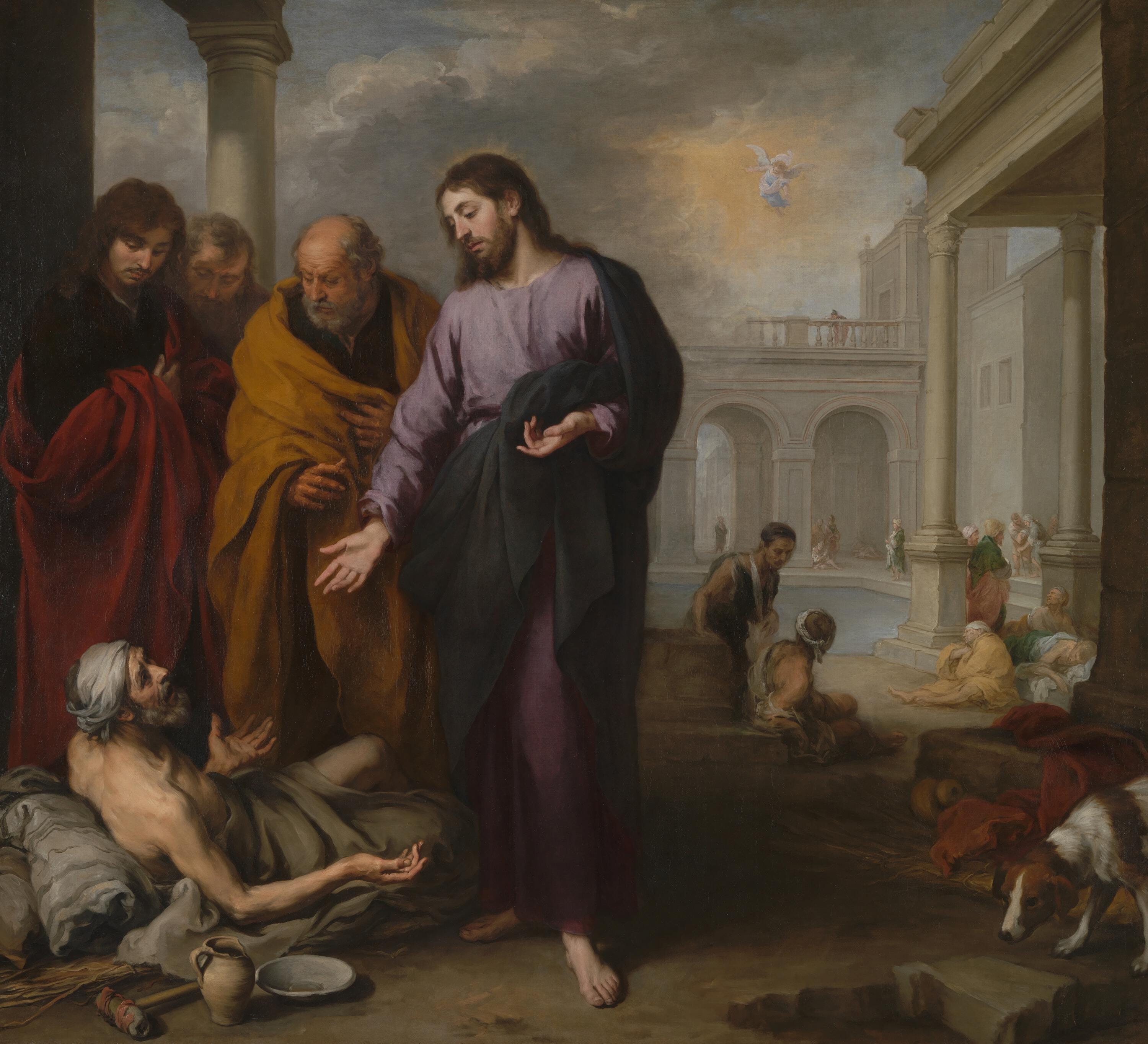
This is the backdrop against which John places the man at the Pool of Bethesda.
He has been ill for thirty-eight years. He lies among a crowd of the sick - the blind, the lame, the paralyzed - all waiting for the water to be stirred. Tradition held that an angel occasionally troubled the surface, and that the first one in would be healed. The man has been here so long, waited so faithfully, that he has become part of the landscape. Jesus asks him a question that must have seemed almost cruel in its simplicity:
“Do you want to be well?”
The man does not say yes. He explains why he has not yet been healed. “I have no one to put me into the pool when the water is stirred up; while I am on my way, someone else gets there before me.” He is not being evasive. He is answering the question that has haunted him for thirty-eight years - the question of the pool, which is a question of timing and proximity and having someone to help. He has been formed so thoroughly by the logic of the place that he cannot hear a different question being asked.
St. Thomas Aquinas, in his treatment of the will, observes that habituated desire can narrow our capacity to receive goods beyond our accustomed horizon - that the will, shaped by long experience of a particular kind of seeking, may fail to recognize the very thing it has been seeking when it arrives in an unexpected form.1 The man at Bethesda is not lacking faith, exactly. He is lacking the imaginative freedom to receive grace from a direction he has not been watching or in a way he has not been expecting.
Jesus does not stir the water or put the man into it. He says: “Rise, take up your mat, and walk.” And the man is healed - immediately, entirely, outside of the framework he had lain within for nearly four decades.
This is the provocation these readings give us in the middle of Lent. Ezekiel’s river does not reward the most prepared or the most patient. It rises and overtakes where God wills. The healing at Bethesda is a sign that the river has arrived - and it does not look like what anyone was waiting for.
The Lenten question is not a simple “what do I need to give up?” but “what framework of seeking have I grown so accustomed to that I might miss grace arriving from an unexpected direction?”
The man’s other answer is also worth sitting with today: “I have no one.” He has spent thirty-eight years in a crowd and remained alone in it. No one has carried him to the water. No one has stood with him at the edge to help him.
The domestic church - the household, the family, the marriage - is where we are called to be someone for another person. Not the angel who stirs the water, but the one who notices the man on the mat, who steps in to help or challenge, or to ask the disorienting question. The witness of faith is not only directed outward, toward the stranger; it begins with those nearest to us, the ones we are most tempted to overlook precisely because they are always there: a spouse, a parent in the evening of their life, or a child who has grown quiet.
“Do you want to be well?” It is a question Jesus asks each of us. But it is also, perhaps, a question we are called to embody for one another - not by having the answer, but by refusing to let those we love remain unasked.
---
Hearth & Altar offers daily prayer and formation for Catholic families, and Eventide & Altar accompanies those in the second half of life through the Church’s daily prayer. Both are rooted in the conviction that what happens at home is not separate from the mission of the Church - it is the first school of faith.
Deacon Michael Halbrook is husband to Suzanne, father of four sons, and a permanent deacon of the Diocese of Springfield in Illinois. He serves at St. Elizabeth Parish in Granite City. He is the founder of Domus Formation, a collection of Catholic prayer and formation resources for every stage of life, and he writes at DeaconMichael.net.
Thomas Aquinas, Summa Theologiae I-II, q. 9, a. 2.