
Caped Crusader: The Dark Knighthood of Batman
A Preview of Voyage Comics' New Book, "Batman & Faith: Essays On the Dark Knight and the Soul"

The following is an excerpt from Voyage Comics’ new book, “Batman & Faith: Essays On the Dark Knight and the Soul.” I contributed five chapters to this great project, alongside excellent Catholic writers including Mike Schramm, Joseph Tuttle, John Tuttle, Thomas Salerno and Daniel Frew. If you would like to read more about the many Catholic themes in the Batman mythos, check out Voyage Comics’ new book here: https://shop.voyagecomics.com/products/batman-faith-essays-on-the-dark-knight-and-the-soul
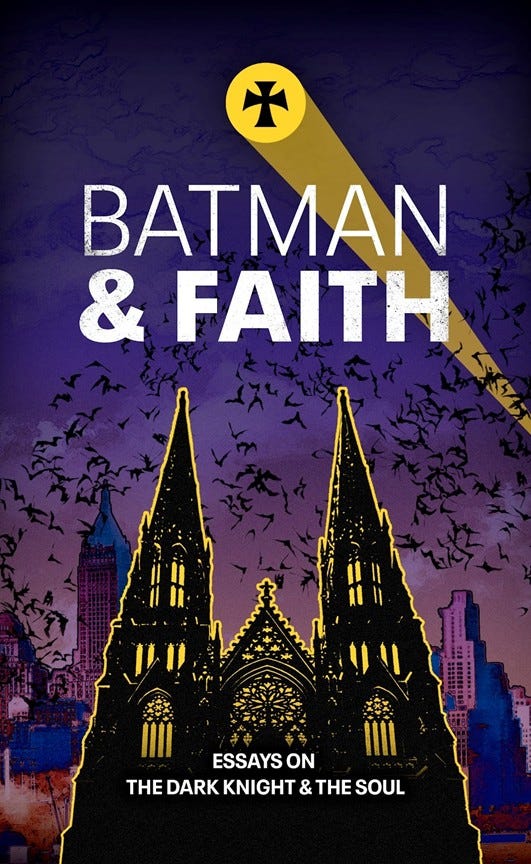
Ever since the first Batman comics, two epithets have stuck with him more than any others: the Caped Crusader and the Dark Knight. In Batman’s original debut, Detective Comics #27, he was already called the Caped Crusader in promotions, and this title was soon featured on comic book covers. Likewise, Batman was first dubbed the Dark Knight in Batman #1 (1940) and this has become one of his most famous descriptives over the years, popularized especially by Frank Miller’s 1986 comic The Dark Knight Returns and Christopher Nolan’s films The Dark Knight (2008) and The Dark Knight Rises (2012). But what do these two titles really mean, and why have they become so characteristic of Batman and his mission?
Both the Caped Crusader and the Dark Knight are essentially medieval images, tied to Catholic Christendom, its chivalric ethos and its heroic crusades. This is why they are uniquely suited to Batman, because of all superheroes in Marvel or DC, especially the more well-known, he is the most medieval. One way to show this is by examining his moral code and his way of life in light of the greatest medieval treatise on authentic Catholic knighthood: St. Bernard of Clairvaux’s De laude novae militae (In Praise of the New Knighthood), written to the founder of the Templars, Hugh de Payens.[1]
St. Bernard outlines the ideal qualities of a true knight of Christ, and while Bruce Wayne is rarely portrayed as explicitly religious, nor does he have the authority to kill that the Templars received from the pope at the time, he still adheres to St. Bernard’s principles in profound ways. For St. Bernard – who was one of the greatest medieval saints and even called “the last of the Fathers” by Thomas Merton – the virtuous athleta Christi (athlete of Christ) fights for justice and fears neither death nor pain because he knows that his cause is just:
He is truly a fearless knight and secure on every side, for his soul is protected by the armor of faith just as his body is protected by armor of steel. He is thus doubly armed and need fear neither demons nor men. Not that he fears death--no, he desires it. Why should he fear to live or fear to die when for him to live is Christ, and to die is gain?
Again, despite his lack of explicit faith in most continuities, Batman lives by this in every way, risking his life courageously even for his enemies and refusing to ever compromise his principles. While instilling the fear of God into his foes, Batman fears nothing, and no matter what affliction he endures, spiritual, mental or physical, even having his back broken by Bane (Knightfall) and his loved ones tortured, paralyzed or murdered (e.g. A Death in the Family, The Killing Joke), he simply learns to pick himself back up, as his father Thomas Wayne taught him (Batman Begins), and rejoins the fight. What could be more chivalrous, honorable and heroic?
Even though Batman (except in the earliest comics) lacks the authority to kill, he is not really different from the Templars in his unwillingness to murder. As Catholics, they also believed that human life should only be taken gravely, solemnly and as a last resort, not for glory, prestige or any other personal benefit. St. Bernard makes this clear: “I do not mean to say that the pagans are to be slaughtered when there is any other way to prevent them from harassing and persecuting the faithful”. Contrary to their popular malignment, the crusaders were not “fanatics,” in Voltaire’s terms, or simply seeking to profit themselves by their adventures.[2] Rather, true crusaders like the Templars risked their lives and often bankrupted themselves to serve Christ.[3] Even though Batman does not kill, he can still be said to fight as a form of “malicide,” as St. Bernard describes it, killing evil rather than people. This is how Batman differs from the true fanatics he fights against, including false knights like Azrael, or the Joker in the White Knight story arc: he values human life and tries to save it, body and soul, whenever he can, and he will not kill even to save his own life. He thus obeys St. Bernard’s teaching:
Whenever you go forth, O worldly warrior, you must fear lest the bodily death of your foe should mean your own spiritual death, or lest perhaps your body and soul together should be slain by him. Indeed, danger or victory for a Christian depends on the dispositions of his heart and not on the fortunes of war. If he fights for a good reason, the issue of his fight can never be evil; and likewise the results can never be considered good if the reason were evil and the intentions perverse. If you happen to be killed while you are seeking only to kill another, you die a murderer. If you succeed, and by your will to overcome and to conquer you perchance kill a man, you live a murderer. Now it will not do to be a murderer, living or dead, victorious or vanquished. What an unhappy victory--to have conquered a man while yielding to vice, and to indulge in an empty glory at his fall when wrath and pride have gotten the better of you! But what of those who kill neither in the heat of revenge nor in the swelling of pride, but simply in order to save themselves? Even this sort of victory I would not call good, since bodily death is really a lesser evil than spiritual death. The soul need not die when the body does. No, it is the soul which sins that shall die… What else is the cause of wars and the root of disputes among you, except unreasonable flashes of anger, the thirst for empty glory, or the hankering after some earthly possessions? It certainly is not safe to kill or to be killed for such causes as these.
This is also why Batman chooses to fight from the shadows, to conceal himself and his heroism instead of popularizing or glamorizing it. Although he respects the other DC superheroes, he will at times critique some of them for their ostentation and narcissism, for what seems (in truth or only in Batman’s eyes) to be a desire for fame and celebrity, or for their flippancy and flamboyance instead of the selfless, anonymous service to the cause of justice that he gives, especially ones like Superman, the Flash (especially those after Jay Gerrick), Green Arrow and Green Lantern (particularly Hal Jordan). Batman instills this spirit of humble service into the other members of the Bat-Family, at least those who would receive it, although some, like Jason Todd and Damian Wayne, resisted it more and at times longed for recognition and validation from others. The Bat-Family thus exemplifies St. Bernard’s guidelines almost exactly:
[D]iscipline is in no way lacking and obedience is never despised. As Scripture testifies, the undisciplined son shall perish and rebellion is as the sin of witchcraft, to refuse obedience is like the crime of idolatry. Therefore they come and go at the bidding of their superior. They wear what he gives them, and do not presume to wear or to eat anything from another source. Thus they shun every excess in clothing and food and content themselves with what is necessary. They live as brothers in joyful and sober company, without wives or children… There is no distinction of persons among them, and deference is shown to merit rather than to noble blood. They rival one another in mutual consideration, and they carry one another’s burdens, thus fulfilling the law of Christ. No inappropriate word, idle deed, unrestrained laugh, not even the slightest whisper or murmur is left uncorrected once it has been detected.
St. Bernard even anticipated the distinction between Batman and Bruce Wayne, and the other secret identities of the Bat-Family members, when he observed of the Templars,
Thus in a wonderous and unique manner they appear gentler than lambs, yet fiercer than lions. I do not know if it would be more appropriate to refer to them as monks or as soldiers, unless perhaps it would be better to recognize them as being both. Indeed they lack neither monastic meekness nor military might.
Despite his extreme wealth and fame, Bruce Wayne lived like a monk. Particularly in the comics, he was most often celibate, even explicitly pledging to remain so at the graves of his parents in the animated movie Batman: Mask of the Phantasm. He eschewed all of the splendor and glitz of his fellow Gotham elites. As Bruce Wayne, he dedicated himself entirely to the betterment of the common good of his city and ultimately of the world, only to risk his life even more by night as Batman. He could be at once kind, gentle and compassionate, as well as fearsome, vengeful and demanding. Like Batman and his allies, St. Bernard’s Templars “think not of glory and seek to be formidable rather than flamboyant. At the same time, they are not quarrelsome, rash, or unduly hasty, but soberly, prudently and providently drawn up into orderly ranks”.
Bruce Wayne knows that, before any mastery of his enemies, it is self-mastery that is most important. He is disciplined, austere, ascetic, restrained and utterly dedicated. He is sober, as shown in the novel Enemies & Allies by Kevin J. Anderson, when Bruce is interviewed by Clark Kent and Lois Lane and appears to be drinking a martini but actually drinks none of it, and the narrative later reveals that it was nonalcoholic.[4] Likewise, Batman is not grandiose or theatrical: his suit is purely functional and symbolic, not flashy. He especially emphasized this in his training of his son Damian, whose upbringing in the League of Assassins had accustomed him to think of himself as special and deserving of praise because of his blood.
One more way that Batman echoes the Templars is in the method of his war against crime. He is violent but not cruel - in most continuities. His desire for vengeance and his willingness to use excessive force to the point of torture is a constant temptation for him (as they were for historic Christian knights) and a theme emphasized in some story arcs more than others. Azrael, Red Hood, Phantasm and Punisher are examples of heroes who fail in this and other aspects of authentic knighthood.
Additionally, Batman fights defensively, to protect the innocent and deter crime, just as the Templars and crusaders fought to defend Christian pilgrims, natives and holy sites in lands conquered by Muslims and to protect the Church against threats of heresy. Though Batman is often portrayed as a kind of predator in Gotham, his intention is always to protect the innocent, not to hunt criminals for the sport of it, and he is willing to die to save even criminals. A powerful example of this same restraint and emphasis on salvation in medieval Christendom is St. Francis’s attempt to convert the Muslims to Christ in his famous meeting with sultan al-Kamil.[5]
In the world of Batman comics, particularly in stories set outside the main canon, he is shown to be medieval and chivalrous. In Dark Knight of the Round Table (1998), Bruce Wayne is reimagined as the lord of a feudal city (Gotham), enforcing justice as Batman, using the bat as a heraldic device (more on this later) and taking chivalry for his personal code. As the title implies, Batman imitates King Arthur with the Bat-Family as his Round Table and Gotham as Camelot. It works well because Batman already reflects this framework even in his modern-day setting. Batman Incorporated is also very feudal, with his organization functioning as a military order like the Templars or Hospitallers. Symbolism, feudal delegation of authority, training knights in other cities, etc. are all highly medieval and chivalric.
Despite these similarities, however, in general, Batman acts more like a knight-errant than a feudal lord. He follows his own personal code of honor, without direct obedience to any secular authority. He trains squires (the Bat-Family) and goes on personal quests for truth and justice. The Dark Knight Returns comic shows this by contrasting Batman as a rogue agent with Superman, who behaves more like a knight in service to a lord (the state). Batman: Gotham Knights in Elseworlds shows this in a literal medieval setting, similar to Dark Knight of the Round Table but with Batman as a knight-errant and Robin as his squire. Batman Beyond is also feudal in this way, with Bruce as an aging knight akin to the Master of the Templars, training Terry to be his successor. Here, Gotham functions as a fortified city with brigands (gangs) and feudal lords (corporate heads) vying for power.
The most relevant and fascinating treatment of this subject, however, is the character of Azrael (Jean-Paul Valley). In most versions, he is portrayed as a Christian fanatic, an extremist raised and trained by the secretive, cultic Order of St. Dumas to restore justice to Gotham City using any means necessary. In truth, however, the name Azrael, meaning “God has helped,” refers to the angel of death in Islamic and Jewish Kabbalistic literature, called Malak al-Mawt in the Koran and Malʾakh ha-Maweth in Rabbinic writings. The name “Dumas” itself is likely a reference to “Dumah” (Hebrew) or “Douma” (Aramaic), another angel of death presiding over wicked souls in the afterlife. This character also appears in Islamic hadiths such as Al-Suyuti’s al-Haba’ik fi akhbar al-mala’ik, which shows Azrael handing over the damned to Dumah.
As Christian knights, both Batman and Azrael are inadequate in their own ways. Azrael exemplifies fanaticism, i.e. religion divorced from reason and magisterial authority, due to his conditioning by a false religious cult that taught him to kill as an act of purification in obedience to God. Based on the aforementioned etymological associations, Azrael is actually closer to an Islamic jihadist than a Christian crusader. By contrast, Batman exemplifies St. Bernard’s model of a Templar, since his violence is (usually) restrained, impersonal and ordered to justice, but he lacks the religious foundation both of Templars and Azrael. Some would see this as a point in Batman’s favor, orienting him more to secular humanism than religious zeal, but it actually makes him unguided and arbitrary and deprives him of any ultimate meaning or objective standard for his actions, thus leading to the criminality seen in some Batman continuities like Flashpoint, where his father became a murderous version of Batman instead of Bruce, or in Zack Snyder’s Batman vs. Superman movie where he is shown killing his enemies.
Another way that Batman is noticeably medieval is in his use of heraldry. While other superheroes tend to use simpler, mythic or more abstract symbols, such as Superman’s Kryptonian S or Flash’s Mercurial lightning bolt, Batman chose to associate his mission with an animal, specifically a bat. This choice was not random: he was drawing, knowingly or not, on the ancient folkloric symbolism of bats to represent the unique way he intended to fight for justice. One of the clearest explanations of this choice was given in Nolan’s first Batman film, Batman Begins, where, after finishing his training with Ra’s al Ghul and definitively aligning himself against the lawlessness of the League of Shadows, Bruce tells Alfred,
People need dramatic examples to shake them out of apathy. I can’t do that as Bruce Wayne. As a man... I’m flesh and blood, I can be ignored, destroyed. But as a symbol... As a symbol, I can be incorruptible. I can be everlasting. [ALFRED] What symbol? [BRUCE] Something elemental... something terrifying.[6]
This dialogue is not only a foundational mission statement for Batman, applicable to his entire mythos and to the heroes who share it with him, but it also reveals the motive behind his choice of a bat for his heraldic device. In medieval Christendom, bats represented liminality, the threshold between worlds: they fly but are not birds, they are mammals yet airborne, they hunt in twilight between day and night. They symbolize living between worlds, existing on the margins and operating where ordinary human rules break down. This suits Batman perfectly, since he is neither criminal nor policeman, neither fully private citizen nor public authority, active where the legal institutions of society have broken down, a protective wall between innocent civilians and supervillains. As John C. Wright explains,
Human psychology has two basic reactions to images of darkness and horror: the first is to be horrified, as if we saw a monster; the second is to be curious what it would be like to horrify, as if we were the monster. For those of us who are not particular fans of stories told from the point of view of vampires, that curiosity can be made palatable if the horrific monster preys only on the guilty. Bats are creepy—but there are creeps in the world who deserve to be scared. For them, there is the Batman.[7]
Bats signify the mysterious, apophatic aspect of darkness rather than the privation of evil. They inhabit darkness not because they are evil, but because they are designed to travel where others cannot see. They thus symbolize operating in obscurity, sensing what others miss and moving where light does not yet reach. Batman likewise operates within darkness in order to enlighten it. He reclaims the darkness from those who pervert it for evil. He instills the fear of God into those who seek to enslave the innocent with the fear and despair caused by their criminality. In Batman’s words, “Criminals are a superstitious cowardly lot. So my disguise must be able to strike terror into their hearts. I must be a creature of the night, black, terrible...”[8] This is also why children have always loved Batman despite his terrifying appearance: he only scares the guilty. Travis Langley thus wrote,
Why don’t children fear this hero who dresses like a monster? Because he’s their monster. He’s ours. Even when children learn that magic will not save them nor will a hero in blue fly out of the sky, so they develop more realistic hopes, they can still hope that when they can’t find the strength to stand up to life’s bullies, someone who is strong and capable might do the right thing and help. In Batman, they see the wounded boy who makes himself big and strong enough to turn fear against the fearsome. With both brain and brawn, he’s the part of us that wants to scare life’s bullies away.[9]
Medieval people often associated bats with fear because they fly silently, hunt in twilight and are largely unique. For this reason, they often put bat wings on depictions of demons. Batman transforms this primordial fear into a deterrent rather than an end in itself, akin to but less problematic than Marvel’s Daredevil. Medievals also saw bats as symbols of vigilance, watchfulness and night guardianship, since they are hypervigilant of their surroundings and able to navigate in total darkness. This suits Batman as the custos of Gotham, according to the medieval idea of a knight as the custodian of peace and justice in his realm.
Ultimately, Bruce’s choice of a bat for his heraldry is a form of humility and self-abasement, forgoing more noble creatures or mythic imagery (e.g. Wonder Woman’s Amazonian eagle, Hawkman’s Egyptian Claw of Horus, Aquaman’s Trident of Poseidon, Doctor Fate’s Ankh). Instead, Bruce’s heraldry is quiet and unassuming but also feared and respected – just like Batman himself, the Caped Crusader and Dark Knight of Gotham City.
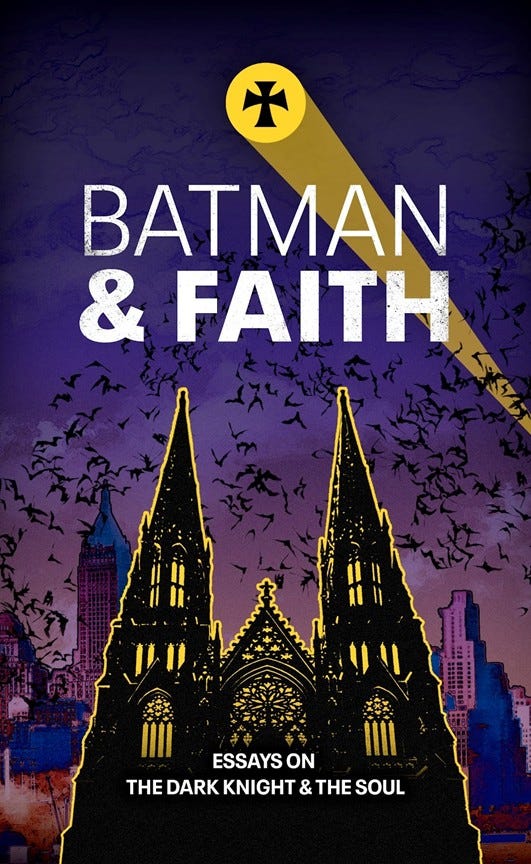
(Cover image source: Batman: Year One (movie), DC Comics, 2011)
[1] Quotes are taken from an excerpt of the full text: Bernard of Clairvaux, In Praise of the New Knighthood, prologue-chapter five, translated by Conrad Greenia OCSO, from Bernard of Clairvaux: Treatises Three, Cistercian Fathers Series, Number Nineteen, © Cistercian Publications, 1977, pages 127-145 (without notes). This excerpt belongs to the Hanover College history department, copyright 1996. All rights reserved. https://history.hanover.edu/courses/excerpts/344bern2.html
[2] Rodney Stark, God’s Battalions—The Case for the Crusades (New York: HarperCollins Publishers, 2009), 6.
[3] Steve Weidenkopf, The Glory of the Crusades (El Cajon, CA: Catholic Answers, 2014), loc 3560-3570. Kindle.
[4] Kevin J. Anderson, Enemies & Allies (HarperCollins, 2009), 16, 70. Kindle.
[5] Weidenkopf, The Glory of the Crusades, loc 3233-3254.
[6] Christopher Nolan, Batman Begins (2005; transcript accessed from Script-o-Rama, https://www.script-o-rama.com/movie_scripts/b/batman-begins-script-transcript.html).
[7] John C. Wright, “Heroes of Darkness and Light,” in Batman Unauthorized: Vigilantes, Jokers, and Heroes in Gotham City, ed. Peter B. Knight (Chicago: Chicago Review Press, 2008), 182-183.
[8] Bill Finger (writer), Batman: The Batman Wars Against the Dirigible of Doom, Detective Comics #33 (November 1939), DC Comics.
[9] Travis Langley, “A Dark and Stormy Knight: Why Batman?” Psychology Today, August 12, 2012.
What a great column! I began piecing iit together as a Templar and Batman fan!
Really enjoyed it, great research.