

19 Now when it was late that same day, the first of the week, and the doors were shut, where the disciples were gathered together, for fear of the Jews, Jesus came and stood in the midst, and said to them: Peace be to you.
20 And when he had said this, he shewed them his hands and his side. The disciples therefore were glad, when they saw the Lord.
21 He said therefore to them again: Peace be to you. As the Father hath sent me, I also send you.
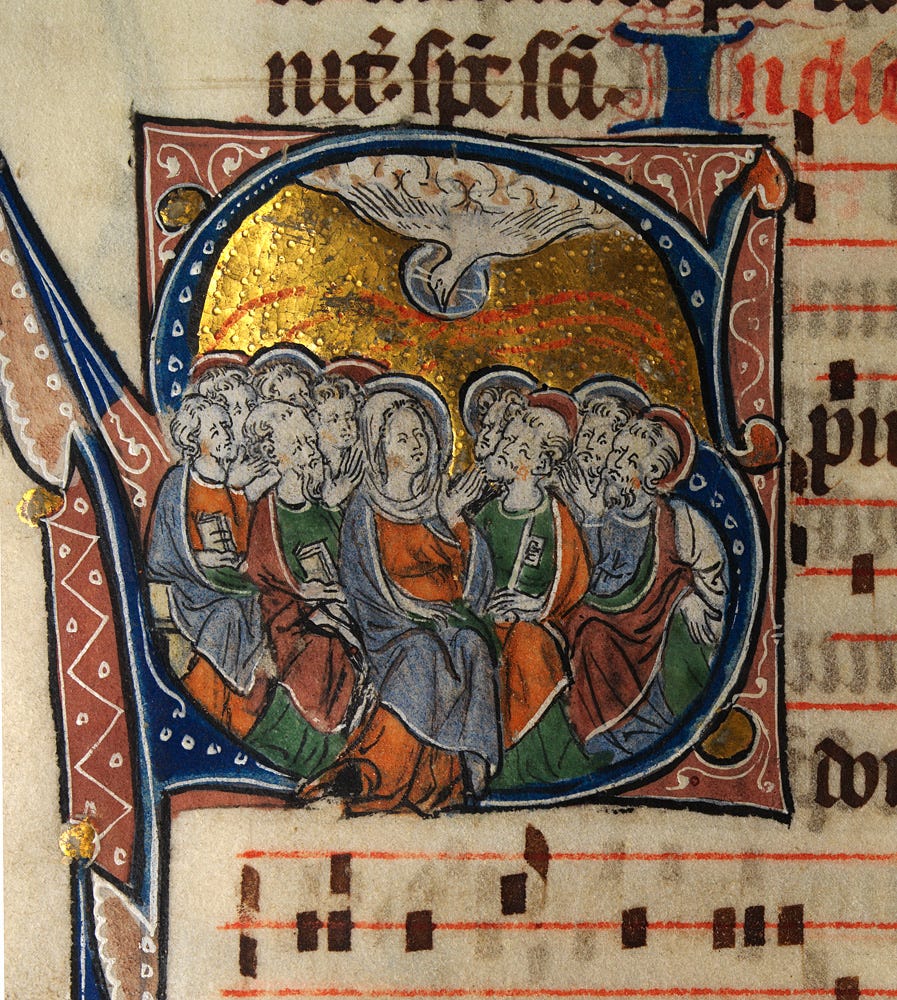
22 When he had said this, he breathed on them; and he said to them: Receive ye the Holy Ghost.
23 Whose sins you shall forgive, they are forgiven them; and whose sins you shall retain, they are retained.
(John 20:19-23 DRA)
PUFF P TAT
You’re probably wondering, what in the world does PUFF P TAT mean? I wondered this at first too, but then I learned that this acronym summarizes the major feasts of the ancient liturgical calendar of Israel: Passover, Unleavened Bread, First Fruits, Pentecost, Trumpets, (the Day of) Atonement and Tabernacles. Besides being a helpful mnemonic device for biblical scholars and Jewish children, this helps us situate today’s feast, which bears the same name as the ancient feast of Israel: Pentecost.
For most traditional cultures throughout the world, the time of day was not the neutral, scientific means of calculation it has become for our demythologized Western minds today. Rather, they understood that all things reflect God and thus are pregnant with meaning. For this reason, they, and especially the ancient Israelites, believed that the “bright blessed day” and “dark sacred night,” in the immortal words of Louis Armstrong, correspond to the time of year, since the days are longer in the Spring and Summer and shorter in the Fall and Winter, and ultimately to deeper religious symbolism related to agriculture and to the recapitulation of historic events. In this sense, morning equates to Spring, noon to Summer, evening to Fall and nighttime to Winter.
The Israelites’ whole liturgical calendar, given successively in the Pentateuch and modified over the centuries, reflected this sacramental imagination. This is why the first three feasts – Passover, Unleavened Bread and First Fruits – all happened in the Spring, to symbolize new life in the day, while the last three – Trumpets, Atonement and Tabernacles – represent the coming dark of night.
As a side note, traditionally for both Jews and Christians, liturgy has been predominantly restricted to daylight, so that no liturgies or feast days took place at “night,” either of the day or the season of the year, but in later Israel, in Esther’s time, the feast of Purim would be instituted, and then Hanukkah by the Maccabees. The Christian calendar continues this, with Purim having occurred a month after Passover with an evening liturgy and later taking on Marian and eucatastrophic Easter connotations, and with Christmas having taken place at night in the Winter in fulfillment of Hanukkah. Christians also preserve the ancient Jewish reckoning of the day as running from sundown to sundown, which is why vigils have always been celebrated in the evening.
This tradition is seen especially in the Divine Office, or what is today commonly called the Liturgy of the Hours. Before the Mass became almost the exclusive experience of the Church’s liturgy for most Catholics following Vatican II, the laity often participated in the Divine Office with the priests, monks and nuns who are obligated to follow it. God thus hallows every hour of the day, corresponding it to the ancient symbolism of time, as Pope Pius XII teaches:
The ideal of Christian life is that each one be united to God in the closest and most intimate manner. For this reason, the worship that the Church renders to God, and which is based especially on the eucharistic sacrifice and the use of the sacraments, is directed and arranged in such a way that it embraces by means of the divine office, the hours of the day, the weeks and the whole cycle of the year, and reaches all the aspects and phases of human life... in different parts of the Christian world the practice arose of setting aside special times for praying, as for example, the last hour of the day when evening set in and the lamps were lighted; or the first, heralded, when the night was coming to an end, by the crowing of the cock and the rising of the morning star. Other times of the day, as being more suitable for prayer are indicated in Sacred Scripture, in Hebrew customs or in keeping with the practice of every-day life. According to the acts of the Apostles, the disciples of Jesus Christ all came together to pray at the third hour, when they were all filled with the Holy Ghost; and before eating, the Prince of the Apostles went up to the higher parts of the house to pray, about the sixth hour; Peter and John “went up into the Temple at the ninth hour of prayer” and at “midnight Paul and Silas praying . . . praised God.” (Mediator Dei, §138, 140)
For ancient Israel, all of history revolved around the Exodus of Moses from Egypt. Their feasts were thus considered to be a participation in or re-presentation of the Exodus, with Passover directly corresponding to the original Passover, the Unleavened Bread to the manna (matzah) in the desert, the First Fruits to the nations’ recognition of God’s salvation initially by Jethro (Moses’s father-in-law) as the first converted Gentile, Pentecost (also called Harvest or Weeks, Shavuot) to the reception of the Law on Mt. Sinai, Trumpets to the sound of trumpets while God was coming down in the glory cloud (Shekinah) onto Mt. Sinai, the Day of Atonement to Moses’s vicarious self-offering for the atonement of Israel following the Golden Calf incident, and finally Tabernacles to the building of the Tabernacle of Moses. This is why Jews even today live in tents on this last feast day.
Pentecost, which occurred 50 days after Passover just as our Pentecost is celebrated 50 days after our Passover of Easter (called Pascha or Passover in non-English languages), is the context for today’s feast, since our first reading from Acts begins by announcing that “the time for Pentecost was fulfilled”. So, just as the Eucharist was instituted at the Last Supper after the Passover meal, to signal its fulfillment, so the new Pentecost occurs after the observances of the original Pentecost are fulfilled. We can also see this by the fact that “there were devout Jews from every nation under heaven staying in Jerusalem”: Pentecost was one of the three pilgrimage feasts of Israel, alongside Passover and Tabernacles, when all Jewish men, even those in the Diaspora outside the Holy Land, were expected to journey to the Temple in Jerusalem.
The association of Pentecost with the Holy Ghost is already prefigured in the ancient feast. From Passover to Pentecost covers from the barley harvest, the first crop harvestable for bread, animal feed and beer, to the wheat harvest, i.e. from the more basic and plain to the finest, so that, being directly in the middle, Pentecost represents the fullness of the harvest. This is why Pentecost was the only day in the Mosaic calendar when leavened bread was eaten, having the same symbolism of the Holy Ghost and resurrection to new life as it does for Eastern Christians, who use leavened bread for their Eucharist.
This typological association between the ancient Pentecost and the new becomes even clearer in light of later Jewish tradition, which connected Pentecost with the giving of the Law on Mt. Sinai. In both Pentecosts, God descended on the leaders of His covenant people (Moses, Aaron with his two sons Nadab and Abihu, Joshua and the 70 elders for the first, the apostles, Our Lady and other disciples for the second) in a fire (the Shekinah and the tongues), gave the Law (on tablets of stone to Moses and in the hearts of Christians) and thus formed and manifested the Church (of the Israelites and now also of the Gentiles through Christ). This is why Pentecost is especially associated with the Sacrament of Confirmation, through which the faithful receive the infusion of theological virtues, gifts and fruits of the Holy Ghost just as Our Lady and the apostles did two thousand years ago.
Today, may we pray for a rediscovery and renewal of these same infusions in our own hearts, that the Holy Ghost will fill us and perfect His every gift in our lives.
Join the Fellowship at Saint Tolkien!
On a sidenote, Louis Armstrongis my all time favorite!