
And It Was Night
Tuesday of Holy Week | Isaiah 49:1-6 | Psalm 71 | John 13:21-33, 36-38

Before the Passion, there is the Servant.
Isaiah’s second Servant Song opens in a register of intimacy and concealment: called from the womb, named before birth, formed as a sharp-edged sword - and then hidden. Tucked away in the shadow of God’s arm. A polished arrow kept in the quiver, unused, waiting. And in the waiting, the thought that perhaps it has all been for nothing. “Though I thought I had toiled in vain, and for nothing, uselessly, spent my strength.”
The Servant does not know, from inside the quiver, what the arrow is for. He knows only that he was made for something, and that the something has not yet come. And then the word arrives - not as consolation exactly, but as expansion: “It is too little for you to be my servant, to raise up the tribes of Jacob... I will make you a light to the nations, that my salvation may reach to the ends of the earth.”
The vocation that looks small is always larger than the servant can see from inside it.
We read this on Tuesday of Holy Week knowing who the Servant is, knowing what the quiver was holding him for. Jesus, on this day, is within hours of his arrest. He has taught in the Temple for three days. He has said what he came to say. And now, reclining at table with his disciples, he is deeply troubled - the Greek etarachthē carries the sense of agitation, of being shaken to the depths. He says: one of you will betray me.
What follows is one of the most compressed and devastating scenes in all of Scripture.
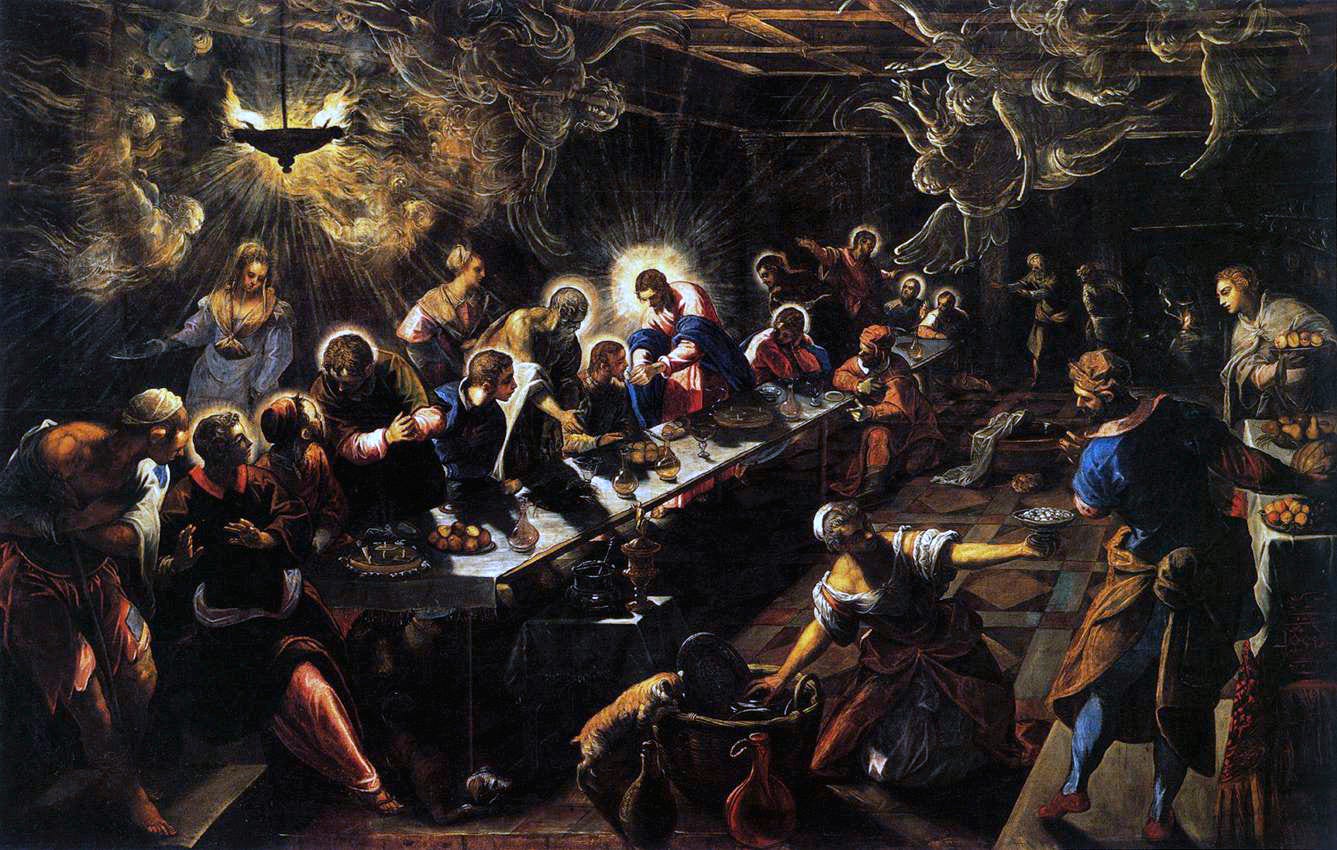
Three disciples, one table, three entirely different postures toward the same Lord, on the same night, within reach of one another.
The Beloved Disciple reclines close - close enough that Peter has to gesture to him across the table to ask the question Peter cannot bring himself to ask directly. He is near to Jesus’s chest, near to the source. He does not make promises or declarations. He simply stays close, asks quietly, and receives the answer.
St. Augustine, in his Tractates on John, reads this proximity as the posture of contemplative love - the disciple who rests on the breast of Christ drinks from the same source as the Word who rests in the bosom of the Father.1 He is not heroic. He is simply present, and his presence is enough.
Peter is the opposite of quiet. “Master, why can I not follow you now? I will lay down my life for you.” The declaration is genuine - Peter means it completely in this moment. And Jesus does not mock him for it. He receives the vow and answers it with a prophecy that is almost tender in its precision: before the cock crows, three times. Not a condemnation. A foreknowledge that leaves room for return.
And then there is Judas.
St. John Chrysostom, in his homilies on John, notes that the dipping of the morsel and handing it to a guest was a gesture of particular honor at the Jewish table - a sign of friendship, of distinction, of being singled out for affection.2 Jesus gives it to Judas. Not as exposure, not as accusation, but as a final gesture of love. A last door left open. After Judas took the morsel, Satan entered him. The door closes from the inside.
So Judas took the morsel and left at once. And it was night.
Augustine returns to this line with the full weight of his theological imagination: the night was not only outside. Judas carried it with him, or rather, it had been growing in him for some time. The exterior darkness mirrors and completes an interior one. And in the same movement, when Judas leaves, Jesus turns to those who remain and speaks for the first time of glory: “Now is the Son of Man glorified.” The betrayal and the glorification are simultaneous. The night and the glory occupy the same moment.
This is the register of Holy Week. Nothing is simple. Everything is happening at once.
---
We are two days from Holy Thursday. In homes and parishes across the world, preparations are being made - sacristans readying things for the great liturgies, families planning how they will observe the Triduum together. Tuesday of Holy Week is among the last quiet days before the extraordinary begins, and the readings give us three figures to sit with as we make our own preparations.
Not “which disciple am I?” as if the answer were fixed.
Instead: which posture am I bringing to the table tonight?
The household table is the domestic altar - the place where all three postures coexist, sometimes within the same meal, sometimes within the same person across the years of a life. There are seasons when we are close, quiet, resting near the source. There are seasons when we are loud with promises we will not quite keep. There are moments - God forgive us - when something in us takes the bread and moves toward the door.
Holy Week does not ask us to have resolved all of this. It asks us to stay at the table. To not be the one who rises and goes out.
The deacon’s role in the Triduum is one of service and presence - to proclaim, to assist, to remain. On Holy Thursday, after the Mass of the Lord’s Supper, the altar will be stripped bare: the cloths removed, the candles extinguished, the tabernacle left open and empty. The church will grow quiet in a way it is not quiet on ordinary days. This stripping is not destruction. It is preparation - the altar made ready to become, in two days, what it was always pointing toward.
The Servant in the quiver did not know what he was being held for. Neither, perhaps, do we, in these final hours before the Triduum begins. But the arrow has been polished. The vocation has been hidden and formed and is about to be released.
Stay at the table. It is not yet night.
---
Hearth & Altar offers daily prayer and formation for Catholic families, and Eventide & Altar accompanies those in the second half of life through the Church’s daily prayer. Both are rooted in the conviction that what happens at home is not separate from the mission of the Church - it is the first school of faith.
Deacon Michael Halbrook is husband to Suzanne, father of four sons, and a permanent deacon of the Diocese of Springfield in Illinois. He serves at St. Elizabeth Parish in Granite City. He is the founder of Domus Formation, a collection of Catholic prayer and formation resources for every stage of life, and he writes at DeaconMichael.net.
Augustine of Hippo, Tractates on the Gospel of John, Tractate 18.1.
John Chrysostom, Homilies on the Gospel of John, Homily 65.
What a beautiful peephole into the most scared of moments you gave us…thank you thank you and thank you
So inspiring Michael, including the artwork. Thank you