
An Interview with John McNichol, Author of The Young Chesterton Chronicles

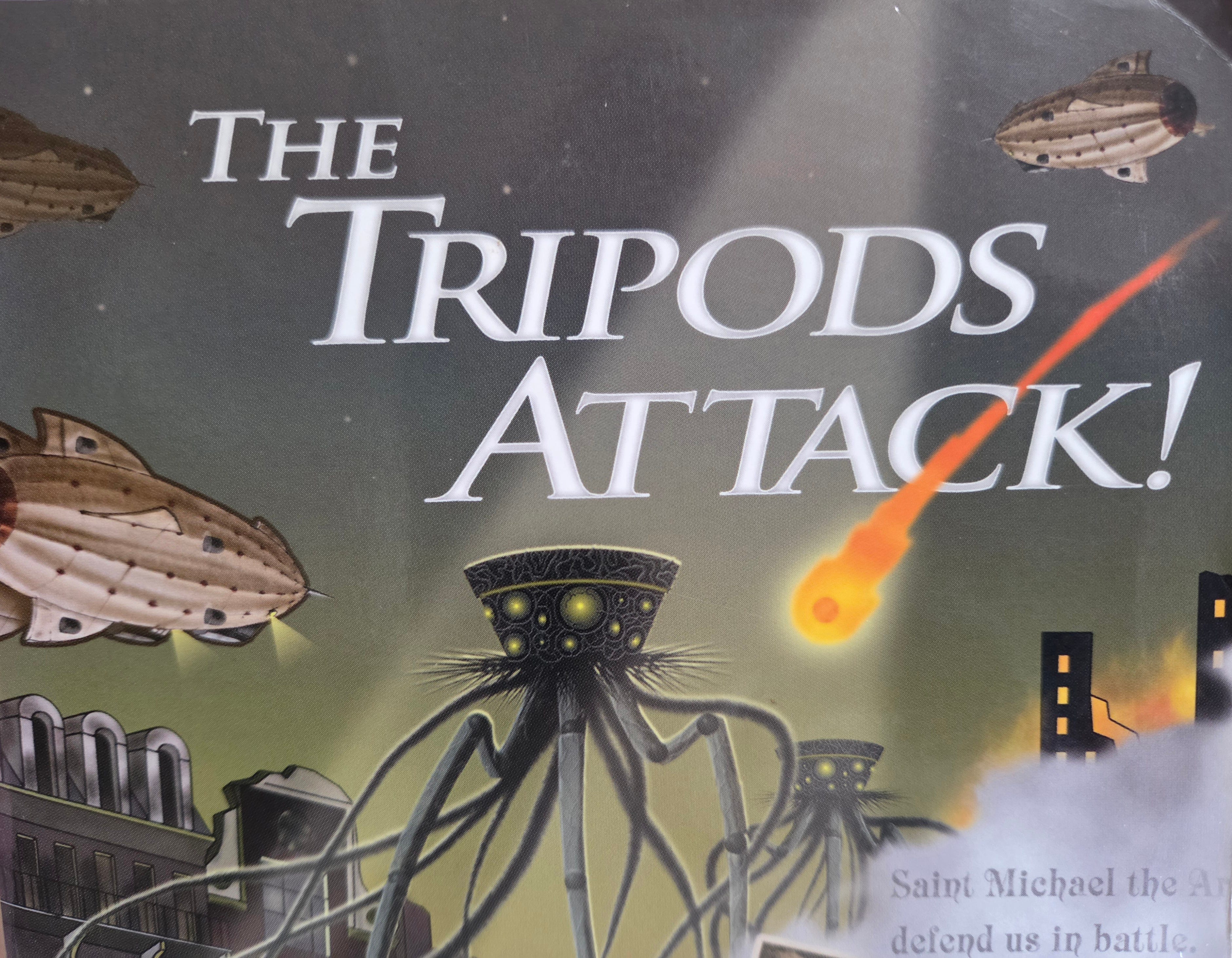
Science fiction is one of the most popular storytelling genres of our day, with its roots in the seminal works of the likes of H.G. Wells and Jules Verne. Notably, Catholic fiction writers have ventured into this space as well, exploring strange new worlds, tantalizing developments in technology, and enduring spiritual and social questions at the heart of the human condition.
In recent years, writer and teacher John McNichol has contributed to this budding genre, particularly with The Young Chesterton Chronicles, a sci-fi trilogy that mythologizes the youthful days of Catholic convert and literary colossus Gilbert Keith Chesterton, blending the Faith, popular science fiction tropes, and Chesterton’s own ideas into an engrossing saga.
The Chronicles, published through the Imagio Catholic Fiction imprint of Sophia Institute Press, began with The Tripods Attack (2008) and came to a close with Where the Red Sands Fly (2024). He has also published some well-acclaimed short fiction. What follows is an email interview with Mr. McNichol that delves into the role his faith has in his life, the joy of storytelling, and the writing craft.
John Tuttle: What drew you to G.K. Chesterton as a Catholic and as a writer? And why did you make him the main character of your first fantasy book series?
John McNichol: I first became aware of Chesterton through the Father Brown series in the 1970s on an episode of a PBS series called Mystery! I later found the book version of the stories, and read a bunch of them; I was 14 then, and my older stepbrother Richard took a look at what I was reading. “Ah, Chesterton!” he said. He often upbraided me for reading ‘pulp’ instead of serious literature, but this time his tone indicated I’d made a good choice.
Much later, I had a thought in my head: I’d been a teacher for a decade, mostly of Middle School, and many of my students’ fiction books they had for book reports followed a familiar pattern: It was always…characters…who’d be classified today as liberal or progressive, that were the ‘good guys.’ If conservative or authentically religious characters were mentioned at all they were mean, nasty, intolerant bigots, who wanted to wreck everyone’s joy just for the heck of it.
I then remembered how in my teen years my own thinking had gotten warped by the same kind of propaganda, and felt my students and my own kids deserved better. They deserved to see the world as it was, rather than how some politicised publisher wanted them to see it. Why not put a writer like GK Chesterton into a story? Chesterton had made a living deflating the pride of the self-important elites of his day. And, if I made him into a teenager, young readers would be able to identify with him all the more.
Plus, at the time I was fascinated by the steampunk genre of science fiction. The elegance and anachronism of this genre in a sometimes cultured, sometimes tough, and often whimsical mix seemed utterly Chestertonian to me, and the perfect environment to put a fictionalised version of him. Steampunk also often has characters that are historical and fictional in the same stories, and the real-life Chesterton had many people in his life and works that were colorful, interesting, dynamic, and opposite to one another…perfect for a work of adventure fiction!
JT: Chesterton did not convert until the age of 48. But your protagonist, this young Chesterton, is much more youthful. How do the fictitious Chesterton and the other characters interact with the Catholic faith?
JM: They say ‘write what you know,’ so I have the stages of my version of Young Chesterton follow many stages of my own conversion story. I was on my way in my early teens to a smug rejection of the Catholic faith. In my 15-year-old wisdom, I thought religion was invented by grumpy adults specifically to deny young people any sense of joy and happiness in life. Gilbert isn’t quite that stupid, thankfully. Granted, he’s never been raised with religion at the beginning of his story, and so he’s more open to it than most atheists are today. By contrast, characters in the series like his friend Herb (based on Chesterton’s real-life best friend of HG Wells - yes, it happens) see the Catholic faith as ridiculous until his own life is threatened and he sees the finish line coming up. Others, like the character of Father Brown, use it as a source of bravery and strength, enabling people of virtue and principle to do the right thing, even in the face of overwhelming odds. Men like the circle of powerful people Gilbert finds himself opposing see power as its own reward, and view the Catholic faith as a pebble in their shoe because of the faith’s tendency to make people refuse to act like cattle when directed to do bad things.
Gilbert converts in the face of near-certain death, and then sticks with it afterwards. I’ve known folks who’ve gone the right way and the wrong way after such a situation, and (without giving too much away), by the end of the series, the faith inspires even those who’ve made bad decisions to make better, sometimes self-sacrificial choices. Others who reject it become gradually more cruel and worldly, as often happens when people have to face real adversity without the guidance provided by twenty centuries of prayer, thought, philosophy, and belief about the human person that the Catholic faith brings to the table.
JT: As a sci-fi series, The Young Chesterton Chronicles weaves together a lot of cultural phenomena. There are Martians and tripods and no shortage of adventure! I believe there are a lot of characters and references to other major sci-fi novels and on-screen franchises. Would you mind detailing just a few of the Easter eggs sprinkled throughout your books?
JM: One of the best parts for me was weaving in a number of Chesterton’s more pithy sayings and literary elements in the story. One of his much-used quotes was “A dead thing can go with the stream, but a living thing can go against it.” It’s easy to support the current political fad but hard to stand up and say [that] something beloved by the modern media is wrong. I address this when Gilbert is stuck in a sewer, tired of running and fighting the bad guys, and thinking about giving up. The sight of a dead fish floating in the underground stream kicks him in the head, and he stands up and decides to keep fighting, even if the ‘currents’ of the conflict push against him.
In terms of characters, I loved working historical and fictional figures into my works. The character of Emperor Norton in The Emperor of North America [the second installment of the trilogy] was based on a real-life con man from the 1800s, for example. You’ll also see references sprinkled in of Catholic saints, such as Therese of Lisieux and Charles de Foucauld.
But my favorite example of this was the red-haired girl! In Chesterton’s fiction, a red-haired girl (RHG, my old editor used to call her) would pop up as a character in all of Chesterton’s books and many of his short stories. Sometimes she’s there for only a few lines, sometimes she’s a major character throughout, sometimes she ‘bookends’ the story at the beginning and end. What a great idea, then, for a fictional character: Someone who jumps in and out of the life of the main character and helps or hinders him, with her actual motivations and connections to him muted and dribbled out over the course of the story! Eventually, folks found out she was an old crush of the real GK Chesterton, and my version of her is based on a certain literary character that virtually no one guessed until the end of the second novel in the series.
I also have references to the works of HG Wells, from the tripods to other pieces, and my second favorite referential characters were a trio of child-geniuses based on prepubescent versions of CS Lewis, JRR Tolkien, and the fictional folk-tale character of Johnny Brainerd. They act as Gilbert’s ‘number one fans’ so many authors are weary of, but they have their own collective arcs and growths, and become close friends in the fashion of the trio of heroes in Tolkien’s The Two Towers.
You could make an argument that I’ve got too much time on my hands…
JT: Historically, H.G. Wells and G.K. Chesterton engaged in some politely antagonistic correspondence. What does the relationship between the two young men look like in The Tripods Attack!, for example? And how do the two characters compare to the men themselves?
JM: When I was a teen, I began taking my faith more seriously. God blessed me by sending some good friends into my life who believed the polar opposite of everything I stood for. We’d argue for hours about abortion, sexual morality, and a host of other issues, but we’d never descend into the screaming matches that today’s woke-jokers are known for.
When I learned that Chesterton counted among his friends men like George Bernard Shaw or HG Wells, I felt a genuine connection to the man. Chesterton noted that the Turkish Saracen and the Catholic Crusader could form a good, manly friendship over arguing if God was one or three persons, and that was true in my life as well.

I portray that in my story. Wells and Chesterton [are] those kinds of friends who exist and build their friendship through both having similar temperaments, but very different outlooks on life. Until he meets Gilbert, Herb Wells has literally never heard or seen a rational person argue effectively in favor of religion or the morality and good life that flows from it. And my version of Gilbert has been raised on a farm by parents who are trying to stay hidden, so he benefits substantially from Herb’s experience living in the more cosmopolitan world.
As for how my versions compare to the real thing: I play and have fun with their backgrounds, like any historical fiction author would. My Gilbert and Herb have different life circumstances than their real life counterparts, but I make sure their outlooks on life are the same. The real-life Gilbert Chesterton was virtually alone among the ‘intelligensia’ of his day as being against the practice of eugenics, the idea that certain races were inherently superior to others, and therefore worth less than others. The real life Wells hated religion to the point of penning essays on why bombing Rome would be a good thing, and by today’s standards would be considered a galloping racist. Through their adventures, Gilbert learns specifically why secular humanism leads to tyranny and authentic religion preserves and reinforces the rights of the individual. Herb learns that his worldview only looks good so long as he believes he’s at the top of the genetic food chain and that true religion isn’t something strictly for the stupid and ignorant in the world. Instead, [it] ennobles man and makes for a better world than secularism can hope for.
JT: How does the richness of your Catholic faith inspire your writing?
JM: When you create, something in you always goes into your creation. It’s why we can tell a painting by Picasso from a painting by Michaelangelo without even thinking about it. Picasso saw the world as twisted and disjointed, while Michelangelo saw God’s creation as a masterpiece to be celebrated. That’s reflected in their artwork.
Me? As I said, the faith inspires my work to portray religious and secular individuals as I’ve seen and experienced them. So many authors writing fiction don’t acknowledge the positive effects of authentic religion at all, and in fact are more comfortable lampooning it unfairly. If you see believers at all in most big media productions, the secularists are portrayed as kind, understanding and gentle folks, while religious people are portrayed as cruel, mean, stupid, utterly powerful and out to wreck everyone’s good time. Feel free to disagree with me (‘Welcome To America,’ I like to say), but in my experience the exact opposite is true. The idea that all men are of equal value is a Christian one. That women are of equal value to men, or that children ought to be loved and cherished rather than seen as raw labor material? Thank you, Christianity. That the poor ought to be valued just as much as the rich, and that there will be consequences for the abuse by the powerful against the powerless? Thank you, Christianity.
Granted, not everyone follows this. When Christian leaders violate this, we get upset precisely because it violates Christian tenets. That kind of atrocious behavior was the standard in the world Christ was born into. In my writing, then, it’s the secularists who tend to hide their brutal agendas behind expensive suits, quiet voices, and other veneers of civilized behavior. It’s authentically religious people who oppose them, and do so because treating people like cattle is wrong. Chesterton noted this when he said you won’t find someone who believes in pure evolution stating that all men are created equal - we’ve certainly evolved unequally!
My faith as I’ve lived it also informs how I write my characters. My villains often use the same arguments I’ve heard secularists make. The ‘useful’ pawns of the elites who haven’t thought too deeply about the ramifications of their own beliefs have a vague idea that they want the world to be a better place, while the masters at the top ultimately want nothing more than power. Also, Gilbert makes a number of rather large blunders in his adventures, as I have in my own life. The character of Herb was based largely on two of my best friends from High School; one went down a bad path, another saw the light. Suffice to say that informed a number of the choices and consequences my character of Herb lived with as well.
As always happens, the arguments of the theists do win out in the end, even in the face of many short-term defeats. The Catholic faith is still here, despite the efforts of many empires of the last twenty centuries trying to crush it. Where is Nero? Where is Caligula? The Roman emperors are long gone, and their city is now the world HQ for the faith they tried to crush.
JT: You’re an educator, in addition to being a writer. How are teaching and writing complimentary?
JM: In my experience? Writing and teaching are both sacred duties. Both are means by which you can change the individual and the world without using violence. I can teach by speaking and showing powerpoint presentations and exposing my students to the truths of great literature. By my own writings, I can teach a point through an enjoyable story, something great fiction authors like Tolkien or Lewis did. By teaching my students to write about their lives or other things that are important to them, I hopefully give them tools with which to live a richer life of introspection, as some of my better teachers did for me growing up.
JT: You’re a father as well as a teacher. I believe children, both our own and students, can teach us things – like facts about life and new ways of seeing a situation – that we wouldn’t think of ourselves. Have you encountered this? If so, what was the context and what did you learn?
JM: Absolutely. Can I write another book about this?
I have seven children, and so far seven grandchildren. My children were in many ways the reason I took up writing in the first place. When I was in my late 20s, I met my biological father’s side of the family, and it absolutely rocked my world in an unprecedented number of ways. My first finished book wasn’t fiction, but my biography up to that point in my life.
I still don’t consider myself the ideal father in any appreciable sense, but in writing my own story, I hoped that my kids would one day understand just why I had the quirks and annoying habits I did while they were growing up. As they’ve gotten older, too, I’ve heard their perspectives on many things. I’ve learned that many of the things I’ve beaten myself up for were actually seen as “pluses” in their eyes, and a number of the things I patted myself on the back for had, in fact, the opposite effects on my kids than I thought they did.
Seeing how my students had gotten very simplistic views of morality from their media-soaked world made me want to tell my stories through fiction, if only to give them a perspective that had been carefully hidden from them [by] the folks at Disney and other cultural elites. What’s nice is that I’ve had, even indirectly, better effects on others than I knew, and been inspired to keep writing and publishing.
Despite the rather large challenges I had in my own background, my kids and students have inspired me to never, ever be complacent with who I am today. Yes, my parents’ divorce was…well, saying it was ‘bad’ or ‘messy’ is like saying World War Two was ‘loud.’ Not inaccurate, but the adjective hardly does justice to the reality. Yes, my parents’ divorce when I was 7 had long-reaching effects on me, my marriage, my children, and presumably my grandchildren. But having and raising kids had long-reaching effects, too. I thought I was doing just fine as a husband and father, until a number of things were brought to my attention and I had to do some serious course-correcting in my own life if I wanted to get my family back on track.
As such, my kids have motivated me to learn that I’m both a better and worse parent than I thought I was, that even my errors had good impacts, and my successes came with a price. And I hope that was reflected in the character of Gilbert, especially in The Emperor of North America. Gilbert learns in the 2nd book of the series a number of things about his family he was unaware of. [He] thinks he’s doing just great as a hero until he realizes he’s on the way to actually becoming the kind of villain he’s fighting against.
JT: You had one of your stories developed into an episode of the Netflix anthology series Love, Death & Robots. Can you tell us about that?
JM: I don’t play Dungeons & Dragons, but I’ve always liked role-playing games as a means where imaginative folks can get together and cooperatively tell a story. Back about 15 years ago, I was running just such a game for my sons. It was a fun little bit of escapism called Weird War, where they were on a World War II bomber shooting down Nazi Gargoyles. We had a ball, and I started thinking about how to flesh it out for the grownups I’d game with.
So, I made a more detailed version of the adventure. I named the plane the Liberty Belle, made up character sheets based on the positions that airmen had on bombers in WWII, and even gave them nicknames from the guys I was in the Royal Canadian Air Cadets with when I was a teen in the 80s. I ran the game for grownup players at the Gamestorm gaming convention in Portland, and it was a big hit!
I enjoyed running that version so much, I turned it into a short story. In it, the rosary saves the day, and the atheist on the crew ends up believing in God after seeing that the spiritual world is a real thing after all. I titled it “How Zeke Got Religion at 20,000 Feet” and eventually sent it off to a magazine called SNAFU that specializes in military-based fiction with a fantasy, sci-fi, and horror flavor.
That was good, and paid a few bills. The story was published in 2019, and I was happy. Three years later, I received an awesome email from the wonderful editors at SNAFU: One of their readers was a fellow named Tim Miller, best known as the director of the Deadpool series of Hollywood films! The story was optioned and eventually made into an animated short for the fourth season of Miller’s show called Love, Death +Robots. The hardest part was that I wasn’t allowed to tell anyone about it, and the release date got delayed for the better part of a year due (I think) to the Hollywood writers’ strike.
Then, I saw the teaser trailer! They only had about one second of footage from the show, the title now shortened to “How Zeke Got Religion,” but it was an incredible thrill to just see the plane’s name, Liberty Belle, and the smile of the pretty girl on the plane’s nose-art peeking through the smoke of the plane as it flew through the flak on its night mission. A dream come true!
However, the film was MUCH bloodier and more violent than the story I wrote. (Caution: Folks, watch it first before you let your kids see it! You’ve been warned.) But, happily, the themes of faith and the rosary were left intact, and every one of the airmen showed the kind of bravery we associate with American servicemen! Best of all, many of the fans said this was their favorite episode of the season. It went on to win TWO Emmy awards!
I’m hoping another piece I’ve penned might get another, similar treatment. Another happy accident is that I’ve managed to get in contact and become social-media friends with a couple of other authors who’ve managed to have their stories turned into LDR episodes. There’s also an anthology available of the stories that were adapted [from] season four [published by] Cohesion Press, and they were kind enough to put a still from ‘my’ episode on the cover!
Best of all have been a number of the comments I’ve seen on the internet from people who watched the episode and said things like, ‘This show made ME get religion!’ Nothing would make me happier about my writing than to hear that folks were left more open to the world of faith after seeing something I had a hand in creating.
JT: You are developing the upcoming superhero comic series EXTRAOrdinary Heroes. Can you tell us a little about the plot and how the idea for it started?
JM: Absolutely! I loved comics as a kid. When I was little, one of my babysitters figured out that if she bought a dollar’s worth of comic books (they were only a quarter then!), she’d keep me quiet for hours. Of course, to ME, it wasn’t quiet. Superman was destroying the latest machine monster of The Toyman! Batman was foiling the Joker’s latest scheme! Casper was outsmarting the Ghostly Trio! And all the rest.
One recent trend I’ve liked is seeing superheroes have and deal with real-life problems in a believable way. Batman has trouble connecting with others. Spiderman has to get his paper in on time after he beats the Green Goblin. Even Zatanna the Magician has to go to AA!
Two trends I haven’t liked were the tendency to see superheroes as either profoundly psychologically damaged or entitled psychos, with no in-between. Another tendency is to use a comic as a pundit for preaching woke, leftist politics.
Add to that: I once met a fellow at a work function who was highly accomplished in the business world, but he couldn’t really converse about anything other than finance or business issues. All of his skills and experience had gone into being an amazing businessman, but he didn’t seem to be able to connect with regular folks, even his immediate family.
Years ago, I ended up working with a fellow who was working two full-time jobs during the week, and a part-time gig on the weekend. His ability to work monster hours with the goal of eventually buying his own business while still keeping a happy attitude was, to me, its own superpower.
I thought, What if there was a case where a normal, ordinary person ended up in the lives of a major superhero team? Real superheroes, if they did exist, likely had put so much time into saving the world that stopping a giant robot would be easy, but they might not know how to do things many of us learn in the course of our lives, like how to keep a marriage together, raise a child, or make and stick to a budget.
So, what if a regular person, with all the skills a regular person has, stumbled into the lives of A-list superpeople? And what if that regular person is at first awed by just being in the presence of greatness and super-abilities, but then realizes these heroes are missing a number of basic skills the rest of us take for granted? If Superman is a superhero because he can stop an alien invasion, then what about the man who keeps the money coming in for his family by working two or even three jobs and still manages to be an effective husband and father?
So, that’s the theme of EXTRA-ordinary heroes! Your life may not be as exciting as Batman, Superman, or Wonder Woman’s. True. But if they were real people, there are things you can do that they could not. An ordinary person who can keep their life going under difficult circumstances may be an ordinary person, but they’re also an EXTRA-ordinary hero!
The plan is to make it a four-issue arc. I’ve written Issues #1 and #2 of EXTRAordinary Heroes. The plot of each story is going to follow the same bare bones theme: An ordinary person is going to find their life affected and entwined with those the superheroes of their world. The ordinary person finds themselves first enthralled with their luck…like someone who just got into a poker game with Brad Pitt, Tom Cruise, and Julia Roberts. But as the ‘norm’ gets to know the ‘capes,’ they realize that the heroes don’t have their lives together any more or less than the rest of us.
In issue #1, a ‘norm’ named Owen makes a food delivery to a mansion and realizes it’s the HQ for the superhero team he’s admired since he was a teenager. While there, he realizes that some of them have a case of arrested development. Others have self-esteem issues. And so on. They aren’t psychos or seriously messed-up, just people who’ve spent so much time saving the world over and over again that this life is all they know. And it’s not their powers per se, so much as that lack of developing everyday skills which has isolated them, set them apart from ‘norms,’ or normal people. Owen learns that even though he’s an ordinary person compared to them, it’s his very ‘ordinary-ness’ that makes him a hero to his daughter and those around him.
JT: Does your faith influence this new comic series either overtly or subtly? If so, how?
JM: I tried to make this story realistic in the sense that most people don’t reveal a lot about themselves immediately to those they don’t have a connection with. Owen teaches at a Catholic school, and one of the superheroes is a Catholic convert, a choice that had ramifications for both of them down the road.
But I’m trying not to make the Faith the central pillar of the story, where the hero will spend two pages telling the reader what they should and shouldn’t do over the course of their lives. Too many in the comics industry have been doing that with their ‘poligions’ (political philosophies substituted for authentic religious belief) for the last few years, and - surprise! - no one wants to read a sermon by a superhero.
Rather, we see Owen [as] a hero for fulfilling his duties as a dad even in the face of extreme adversity. When one of the superheroes gives him the chance to fulfill a dream he’s had since he was a teenager, he almost says ‘yes’ right away. But he hesitates, thinking first how fulfilling his dream might affect his daughter. It’s this ability to put your responsibilities ahead of your wants that makes you a hero, doing what you ought to do over what you want to do. That’s what makes an ordinary person an extraordinary hero. I see that as how the faith has subtly influenced the story. The Catholic faith emphasises family, work, duty, and a host of other things as holy in their own right, in that one can become a saint by doing them right. As one dear friend put it to me, “There’s dignity in wiping butts.” Doing small, ordinary things without complaint out of love for others makes you a hero, every bit as much as Superman stopping an alien invasion or Batman putting the Joker in jail for the 10,000th time.
In fact, doing those small, ordinary things makes you MORE of a hero, really, since Superman doesn’t exist. But the child in front of you who needs a ride to soccer practice does.

JT: How can those interested in your work follow the developments of EXTRAOrdinary Heroes?
JM: We’re doing a fundraiser for expenses on FundMyComic.com. Folks who want to support by dropping a few bucks, or reserve their copy in advance, can hop over to the website and do so! You can also check out my author website, johndmcnichol.com, where I blog about new developments in my writing projects and shill for my books.
JT: Lastly, why do you write?
JM: Why do you breathe?
Okay, it sounds snarky, I know. But the truth is, if I didn’t write my stories down, all they’d do is play knock-around in my head for weeks, months, years. For me, writing fiction is a way to let the stories out of my head. It’s really that simple. There’s always going to be that little fifth-grader in Mr. Stuart’s class who wasn’t good at anything, but got quiet kudos from folks when I read my five-page story about a couple of brothers making a flying saucer. Or a cowboy becoming a superhero. Or…
You get the idea. It’s a combination of validation and eviction. Even those stories of mine that never get published get printed, and they’re there, in print. And maybe someday I can find them a home. Moreover, writing those stories down makes room in my head for the next story, and the next, and the next…making money would be nice, but being able to put a story in people’s hands and know they liked it will always take precedence over any monies I make.
If you’re interested in reading The Young Chesterton Chronicles, check them out here:
***
This was awesome! I loved reading this. Have to check out these stories now. :)