
A Kingdom of Priests
Gospel Reflection for June 14, 2026 - Matthew 9:36-10:8

36 And seeing the multitudes, he had compassion on them: because they were distressed, and lying like sheep that have no shepherd.
37 Then he saith to his disciples, The harvest indeed is great, but the labourers are few.
38 Pray ye therefore the Lord of the harvest, that he send forth labourers into his harvest.
1 And having called his twelve disciples together, he gave them power over unclean spirits, to cast them out, and to heal all manner of diseases, and all manner of infirmities.
2 And the names of the twelve apostles are these: The first, Simon who is called Peter, and Andrew his brother,
3 James the son of Zebedee, and John his brother, Philip and Bartholomew, Thomas and Matthew the publican, and James the son of Alpheus, and Thaddeus,
4 Simon the Cananean, and Judas Iscariot, who also betrayed him.
5 These twelve Jesus sent: commanding them, saying: Go ye not into the way of the Gentiles, and into the city of the Samaritans enter ye not.
6 But go ye rather to the lost sheep of the house of Israel.
7 And going, preach, saying: The kingdom of heaven is at hand.
8 Heal the sick, raise the dead, cleanse the lepers, cast out devils: freely have you received, freely give.
(Matthew 9:36-10-8 DRA)
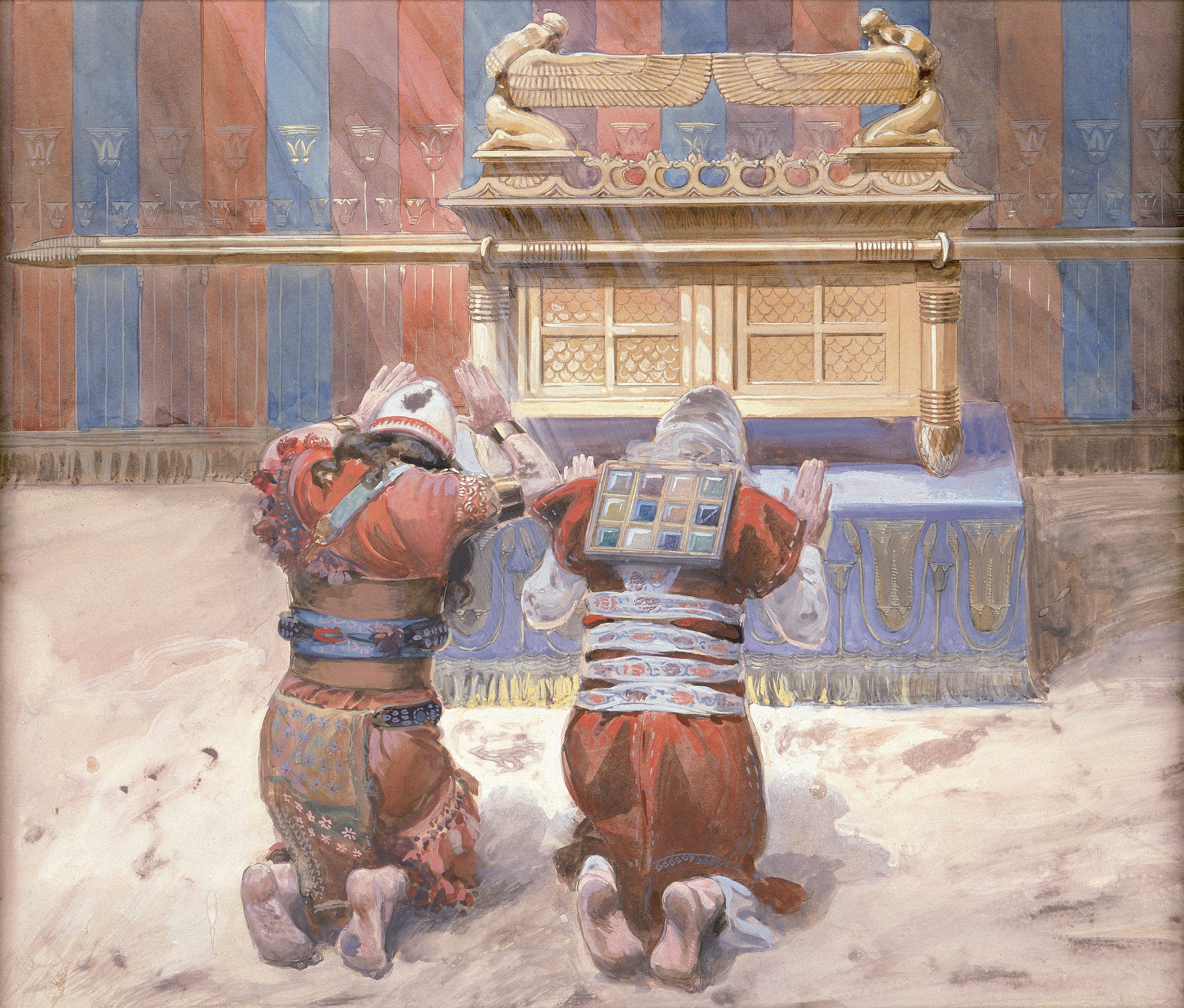
Among other things, the readings for this Sunday focus on one shared theme: the distinction between the ministerial and common or universal priesthood. The same distinction existed in the Mosaic covenant that now exists in the new covenant established by Christ. This is why, in the first reading, God calls the Israelites in general “a kingdom of priests”, even though only the Levites have a priestly ministry in the Tabernacle.
In the new covenant of the Church, the same structure exists: Christ is our true Shepherd and High Priest, the new Moses; St. Peter is His vicar on Earth, the new Aaron; the bishops and priests of the Church carry on the role of Aaron’s descendants, those who ministered as priests in the Temple; and deacons assist in the Levitical ministry of service to the clergy and laity, acting as a kind of bridge between the two priesthoods. The priests of the Church stand in for the bishops, who themselves stand in for Christ as the shepherds of the Good Shepherd, just as the priests of the Temple acted with the authority of Aaron who was himself the proxy of Moses.
The common or universal priesthood applies to the all the baptized, just as it once applied to all those who received circumcision, the Old Testament prototype of Baptism. We are not ministerial priests, and this distinction, which tends to be muddied in the Novus Ordo, should be clearly emphasized, so that only those with holy orders (or children not yet culpable for sin) minister in the sanctuary, touch what is sacred (particularly the consecrated Host and Chalice) and communicate the Sacraments to the faithful, just as it was in the Temple.
Nevertheless, all the baptized faithful, those confirmed in the one true Church of Rome and in a state of grace, are capable of a true priestly service to God, with the same features that once characterized the original priesthood of Adam and Eve. In St. Paul’s words, we can “present [our] bodies a living sacrifice, holy, pleasing unto God, [our] reasonable service” (Rom 12:1). We do this by offering to God all that we do, every suffering we endure without succumbing to sin and each good work we accomplish by His grace. This is what it means to “Pray without ceasing” (1 Thess 5:17), as St. Paul exhorted, so that our entire lives become a prayer to God.
The greatest expression of our baptismal priesthood, however, comes at the Holy Sacrifice of the Mass – not through the ‘active participation’ of external busyness popular today but in the ‘actual participation’ (participatio actuosa) championed by the early proponents of the Liturgical Movement. These figures emphasized what they called ‘liturgical piety,’ which involves praying interiorly in union with the priest at Mass, offering ourselves on the altar when the species of the Eucharist are consecrated.
The offering of everything in our lives, good and bad, to God that we do every day is raised to a sacramental level when we join this offering to the priest’s oblation of the Eucharist, and this liturgical piety can then flow into our daily life through what David Fagerberg calls ‘mundane liturgical theology’, the consecration of the world to God. We thus fulfill Adam’s original vocation to offer Creation back to God through prayer, virtue and subcreation.
The clergy of the Church truly are the ministerial priesthood of the new covenant, empowered by Holy Orders to act in the person of Christ (in persona Christi) for us. Their role in the Church is vitally important, most of all for the transmission of Tradition and the distribution of the Sacraments. But the Church is not simply synonymous with the clergy, no more than the “kingdom of priests” was limited only to the Levites. Lay Catholics are also “a chosen generation, a kingly priesthood, a holy nation, a purchased people” (1 Pt 2:9), called to the ‘reasonable service’ St. Paul commanded. By performing the spiritual and corporal works of mercy, studying Scripture and Tradition every day and praying without ceasing, we are sanctified and conformed into a perfect likeness of Christ our High Priest.
This is what it really means to be a disciple of Christ, to be a member of His Mystical Body the Church and to become a saint.
Join the Fellowship at Saint Tolkien!