
A Bright Cloud Overshadowed Them
Gospel Reflection for March 1, 2026, the Second Sunday of Lent - Matthew 17:1-9

And after six days Jesus taketh unto him Peter and James, and John his brother, and bringeth them up into a high mountain apart:
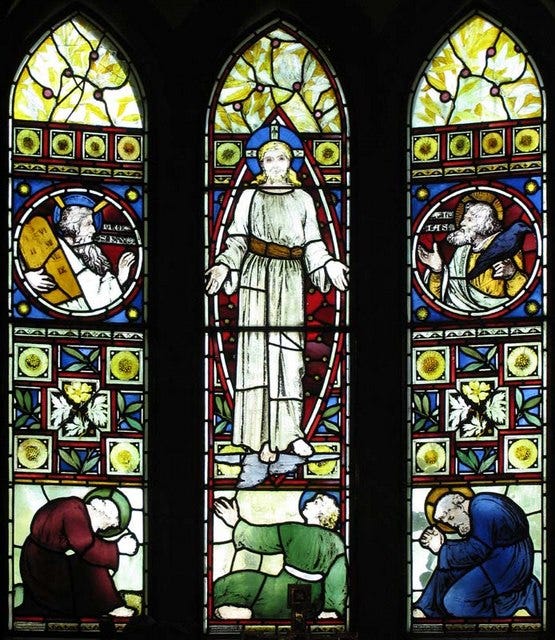
And he was transfigured before them. And his face did shine as the sun: and his garments became white as snow.
And behold there appeared to them Moses and Elias talking with him.
And Peter answering, said to Jesus: Lord, it is good for us to be here: if thou wilt, let us make here three tabernacles, one for thee, and one for Moses, and one for Elias.
And as he was yet speaking, behold a bright cloud overshadowed them. And lo, a voice out of the cloud, saying: This is my beloved Son, in whom I am well pleased: hear ye him.
And the disciples hearing, fell upon their face, and were very much afraid.
And Jesus came and touched them: and said to them, Arise, and fear not.
And they lifting up their eyes saw no one but only Jesus.
And as they came down from the mountain, Jesus charged them, saying: Tell the vision to no man, till the Son of man be risen from the dead. (Matthew 17:1-9 DRA)
The readings for this second Sunday of Lent focus on the profound event of the Transfiguration of Christ, the most explicit revelation of His divinity in the Gospels. The Transfiguration, like every other passage in Scripture, is capable of infinite interpretation, since God is its Author. Two themes I would like to examine, and which St. Matthew’s version particularly fulfills from the Old Testament in accordance with his primarily Jewish audience, are apophaticism and the sacramental theology of light.
Apophaticism is a branch or more precisely a method of theology that contemplates God as utterly transcendent and unknown in Himself – even with the help of revelation, as Pope Leo XIII once wrote, “the sacred writings are wrapt in a certain religious obscurity, and... no one can enter into their interior without a guide”. This is the Cloud of Unknowing, as the medievals called it, rooted in the patristic theology of St. Dionysius the Areopagite, whose influence on medieval scholasticism was almost unrivaled. He taught that God is known by “remotion” from the created world, i.e. by excluding all creaturely imperfections and limitations from God. So, while creatures are limited by place, God is omnipresent; while creatures have only limited power, God is omnipotent; etc. In this way, by reason alone, we can know what God is and that He exists, but always indirectly and analogically. We only know who He is – the Blessed Trinity – and what He has done in history through revelation.
At the Transfiguration, apophaticism is shown especially through the “bright cloud” (a symbol of the Holy Ghost) which, despite or even because of its light, also “overshadows” the disciples, recalling the great glory cloud or Shekinah which overshadowed Mt. Sinai and the tent of meeting in the Tabernacle during the Israelites’ exodus from Egypt. God’s presence is thus simultaneously enlightening and darkening, revelatory and obscuring. They can see all things in God, yet by peering into His light, they become blinded, as though they were staring at the Sun. This is why St. Thomas Aquinas taught that it is only by the gift of created grace, specifically the grace of the Beatific Vision in Heaven, that our intellects can be elevated to see God’s essence directly. In this life, like the disciples, we can only see Him indirectly, through reason and sacramental symbolism.
This brings us to our second theme: the theology of light. In Latin theology (I will refrain from addressing the issue of Palamism, divine energies and Taboric light here), physical light is a sacramental symbol of the divine, uncreated light of God, the glory which is the same as His essence. Christ shone with created light to symbolize His divinity. In ordinary life, the sacramental imagination is the primary means by which God reveals Himself to us. Accordingly, human marriage is a sacramental symbol – meaning both an image of and a real participation in – the marriage betwixt Christ and the Church; the Tabernacle, Temple and now Catholic churches are sacramental symbols of the heavenly Temple and liturgy; and most powerfully of all, the humanity of Christ is a sacramental symbol of the Son of God, so that, as Christ said, “he that seeth me seeth the Father also.” (Jn 14:9) For us today, the most powerful sacramental symbol we can experience is the Eucharist, in which both the humanity and divinity of Christ are signified and made really present.
In medieval Christendom, the sacramental theology of earthly light as a sign of the divine light of God was most supremely elevated by Abbot Suger. In his renovations of the Basilica of Saint-Denis, he introduced Gothic architecture, making it so that the stone walls could be as thin and insignificant as possible, thus allowing him to almost entirely replace the walls with stained glass and let light flood the interior of the church (an effect increased even further by later iterations of Gothic such as Rayonnant). This was not merely practical, in an age before electricity, or even aesthetic, though beauty as a transcendental property of God was certainly an important factor. Even more significantly, Abbot Suger saw light as a sacramental symbol of divine light, so that during the Holy Sacrifice of the Mass, when we participate with the angels and saints in the heavenly liturgy, we can be reminded of the Transfiguration and mystically taken up in body and soul to the presence of God,
“Who only hath immortality, and inhabiteth light inaccessible, whom no man hath seen, nor can see: to whom be honour and empire everlasting. Amen.” (1 Tim 6:16)
For this reason, the great Catholic (unbeknownst to most Englishmen) architect of the Houses of Parliament, Palace of Westminster and Sovereign’s Throne of England, Augustus Pugin, saw Gothic architecture as the most purely and perfectly Catholic form of architecture (his designs were rejected by Oxford University because of his conversion to Catholicism). Alongside its Edenic intertwined pillars resembling trees, its great verticality anagogically lifting the minds and hearts of the faithful to God and its traditional cruciform, ad orientem shape, it is also the most luminescent of all forms of Christian architecture, so that its windows become alive with the light of God, changing from the light of the “bright cloud” to the apophatic darkness of its “overshadowing” throughout the course of the day and illuminating the minds of the faithful with the images of saints and sacred history.
In the modern world, which is so fundamentally shaped by scientism, materialism and pragmatism, it can be difficult to recover this worldview, shaped both by apophaticism and sacramental imagination, the very mind that made the Transfiguration intelligible to the disciples. But as Catholics we must recover it, or else risk losing that which makes us truly Catholic when we forget that Creation itself is a stained glass window, an iconic portal revealing God, and all that we do, if ordered to Him by grace in faith, hope and charity, is a sacramental participation in Christ which divinizes us and conforms us to His perfect likeness.
Join the Fellowship at Saint Tolkien!
The Uncreated Light of Divine Grace upon Mount Tabor....